 how-to
How to Identify Quality Upholstery Craftsmanship
Table of Contents
- How to Tell If a Sofa Is Good Quality: A Room-by-Room Inspection Checklist
- What Upholstery Seam Quality Reveals About Workmanship
- Fabric Durability and Cushion Specifications That Matter
- Questions to Ask an Upholsterer Before Hiring
- Evaluating Craftsmanship from Photos and Online Listings
- How to Identify Quality Upholstery Craftsmanship in Practice
- Conclusion: Making a Confident Choice
- Frequently Asked Questions
Last Updated: October 12, 2026
How to Tell If a Sofa Is Good Quality: A Room-by-Room Inspection Checklist
Quality upholstery craftsmanship comes down to a simple test: does the piece hold its shape, feel solid, and show clean work at every seam? At Creative Custom Upholstery, we've spent over 45 years repairing furniture that failed early and restoring heirlooms that outlasted their owners.
Most buyers check the fabric first. That's backwards. Fabric is replaceable. A weak frame is not.
Frame and Joinery Checks
The frame is the skeleton, and good joinery holds it together. A hardwood frame with glued and screwed joints, corner blocks, and dowels outlasts a stapled softwood frame by decades.
Here's what to check:
- Lift one corner. A solid frame keeps the other three feet on the floor. If it twists, walk away.
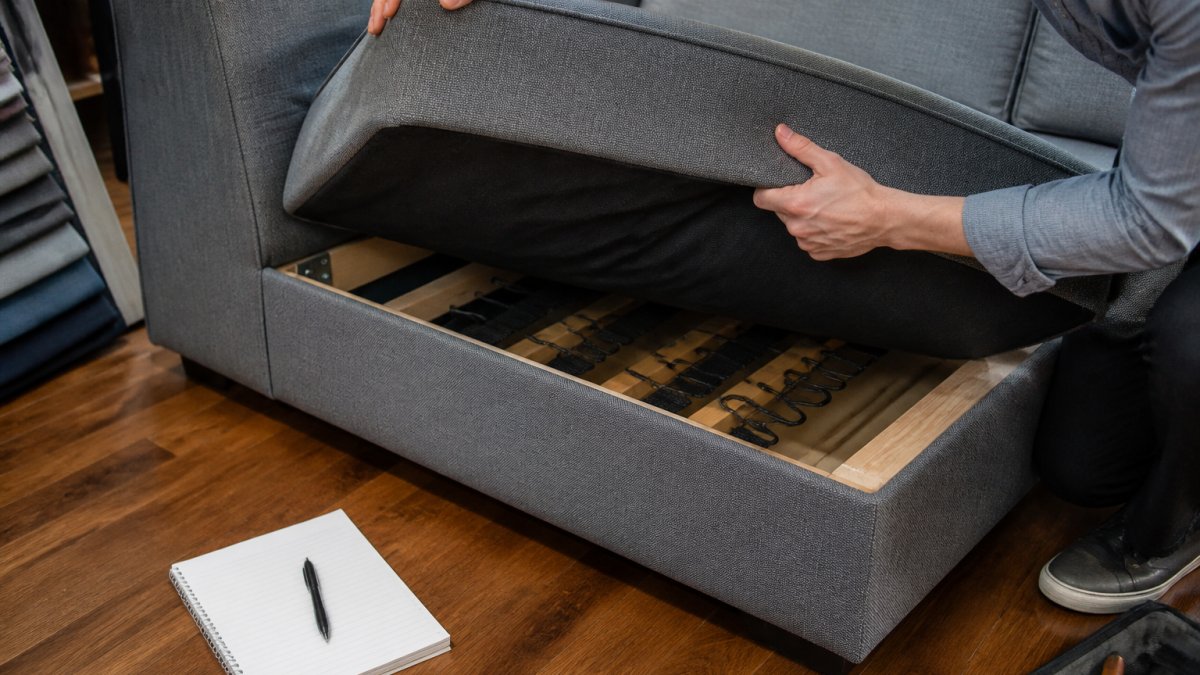
- Look underneath. You want kiln-dried hardwood, not particleboard or plastic.
- Check the joints. Corner blocks and dowels signal real joinery. Staples alone do not.
A common mistake is assuming weight equals strength. Heavy particleboard feels substantial and fails in three years.
Suspension and Spring Tests
Suspension systems carry every person who sits down. Eight-way hand-tied springs offer the best support and last longest; sinuous springs cost less and suit light use; webbing suits occasional seating only. Press down hard on one seat cushion: even resistance and silence mean it's sound. A creak or clunk means the suspension is failing.
Cushion and Padding Assessment
Cushion density decides comfort and shape retention. High-resilience foam holds its loft for years. Low-density foam flattens within months.
Squeeze a cushion and let go. Good foam springs back fast; if your handprint lingers, it's too soft. Ask what the core is made of: high-resilience foam, wrapped foam, or fiber fill. Fiber fill feels plush but needs frequent fluffing.
What Upholstery Seam Quality Reveals About Workmanship
Seam quality is the fastest read on upholstery craftsmanship. Straight, even stitching with matched patterns means a skilled hand made that piece. Wavy seams, loose threads, and mismatched prints mean corners were cut.
Turn the piece over. Check the seams you're not supposed to see.
Stitching Consistency and Pattern Matching
Run your eyes along every seam. Stitch length should stay even from start to finish. On striped or floral fabric, the pattern should line up across seams and around corners.
- Stitch consistency: even spacing, no skipped stitches, no loose threads
- Pattern matching: stripes align, motifs continue across seams
- Seam tension: flat fabric, no puckering or pulling
Pattern matching wastes fabric, which is why budget pieces skip it. That waste is the cost of real workmanship.
Welting, Piping, and Tufting
Welting and piping hide raw seams and add structure; they should feel firm and sit straight, and lumpy or twisted piping signals rushed work. Tufting should be evenly spaced and pulled tight, with no sagging between buttons, uneven diamonds mean the maker cut corners elsewhere too.
Fabric Durability and Cushion Specifications That Matter
Fabric specs tell you how the piece will look after five years of daily use. Four numbers matter: rub count, fiber content, colorfastness, and foam density. Ask for all four in writing.
Rub Count, Fiber Content, and Abrasion Resistance
Rub count (double rubs, or the Martindale abrasion rating) measures how many back-and-forth rubs a fabric survives before showing wear. The standardized test makes the number comparable across mills and retailers. As a working guide:
- Under 15,000 double rubs: decorative or occasional use only, accent chairs, a guest room, a formal living room nobody sits in.
- 15,000-25,000: light residential use, one or two adults, no pets or children.
- 25,000-30,000: general residential use, the common floor for a family sofa.
A high rub count does not rescue a loose weave. Abrasion resistance and structural integrity are separate properties, and a loosely woven fabric with a 40,000-double-rub rating can still pill and snag.
Fiber content shapes feel, cleanability, and lifespan. Common upholstery fibers and their trade-offs:
- Polyester: durable, fade-resistant, easy to clean, can pill. The workhorse of mid-priced furniture.
- Nylon: very strong and abrasion-resistant, often blended in small percentages to boost durability.
- Olefin (polypropylene): moisture- and stain-resistant, common in outdoor and marine applications, can flatten under sustained load.
Blends are the norm. A polyester-cotton or polyester-nylon blend usually outperforms either fiber alone for residential seating.
Colorfastness matters most for pieces near windows, in sunrooms, or outdoors.
| Check | What Good Looks Like | Why It Matters |
|---|---|---|
| Rub count | 25,000+ double rubs for a family sofa; 50,000+ for commercial | Resists abrasion and thinning |
| Fiber content | Tight weave, quality fibers, sensible blend | Less pilling, better shape retention |
| Colorfastness | Rated for expected light exposure | Prevents fading |
| Cleanability code | W, S, or WS matched to your household cleaners | Prevents set-in stains |
| Fabric hand | Firm body, slight stretch, quick recovery | Holds shape, resists sagging |
Cushion Core Density and Foam Grades
Foam grade is the most overlooked spec in upholstered furniture. High-resilience (HR) foam keeps its shape; cheap foam collapses. Density, in pounds per cubic foot (lb/ft³), is the number to ask for.
- 1.0-1.5 lb/ft³: low-density, used in budget furniture, flattens within months under daily use.
- 1.8-2.0 lb/ft³: the common residential baseline, acceptable for light use.
- 2.5 lb/ft³ and up: high-resilience foam, the standard for a sofa expected to last a decade or more.
Density is not firmness: a high-density foam can be soft or firm, and a low-density foam can feel firm on day one and still collapse. Ask about both density and indentation load deflection (ILD), which describes how firm the foam feels under load.
For commercial seating, specify density and rub count in the quote, booths and restaurant chairs take far more use than a living room sofa.
Questions to Ask an Upholsterer Before Hiring
The right questions separate a craftsman from a fabric stapler. Ask these before handing over a family heirloom or dining chairs.
On the frame and structure
- What frame repairs are included, and how do you fix loose joints? A good answer names the method: regluing and re-doweling, adding corner blocks, sistering a cracked rail, or replacing a broken leg. "We'll tighten it up" is a warning.
- Will you strip the old upholstery so I can see the frame before you rebuild? Reputable shops welcome this, it's when hidden rot, bad repairs, or insect damage surfaces.
- Do you replace the suspension, or reuse it? Eight-way hand-tied springs can often be retied; sinuous springs and webbing are usually replaced. Ask which applies to your piece.
On fabric and materials
- How do you measure fabric so we don't run short? Expect a real method: measuring each panel, adding seam allowance, accounting for pattern repeat and railroad direction. Pattern matching on stripes and florals can add 20-30% to yardage.
- Do you supply fabric, or do I? Both work, but clarify who owns the risk if yardage is short or the dye lot varies.
- What foam density do you use, and can I specify higher? A shop that quotes density in lb/ft³ knows its materials.
On scope, timing, and price
- What is the full scope in writing? The estimate should list what is replaced (foam, webbing, springs, decking, welt, buttons) and what is reused.
- Is the quote firm or an estimate, and what triggers a change order? Frame damage found after stripping is the most common surprise. Ask how it's priced and whether you get a call before work continues.
- What turnaround time should I expect, and what is the deposit? Custom work typically runs several weeks depending on fabric lead time and shop backlog. Get deposit, balance, and pickup terms in writing.
On proof of work
- Can I see photos or references from recent jobs, especially ones like mine? Ask for a piece similar to yours, a tufted chair, a channel-back sofa, a boat cushion, not just a general gallery.
- Can I visit the shop? A working shop is loud, dusty, and full of half-finished frames. That is a good sign.
Warranties, Repairability, and Lifecycle Cost
A workmanship warranty is a promise about the seams, frame, and suspension, the parts the upholsterer controls. Ask what it covers, how long it runs, and what voids it.
- Coverage: seams, stitching, spring tying, frame repair, and foam replacement are the usual inclusions. Fabric is typically covered by the mill, not the shop, and wear is usually excluded.
- Duration: a one-year workmanship warranty is common; longer terms signal confidence. Get the start date, from delivery, not deposit.
- Exclusions: misuse, pet damage, improper cleaning, and sun fading are standard exclusions. Ask which cleaner is approved for your fabric so you don't void coverage by accident.
Repairability matters as much as the warranty. A piece built with screws, dowels, and corner blocks can be opened, tightened, and rebuilt; a glued-and-stapled piece often cannot be disassembled without destroying it.
Lifecycle cost beats sticker price. A well-built sofa that lasts 20 years costs less per year than a cheap one replaced every five.
Request a quote for your piece and we'll walk you through the details.
Evaluating Craftsmanship from Photos and Online Listings
Photos hide flaws but leak clues. Ask for close-ups of the seams, underside, and frame joints, sellers who refuse are telling you something.
What to look for in listing photos:
- Straight piping along every edge, with no twisting
- Matched patterns across cushions and seams
- Tight, even stitching visible in close-ups
If a listing shows only wide shots, ask for more. A blurry photo of a seam is a red flag, not a small detail.
How to Identify Quality Upholstery Craftsmanship in Practice
Here's the full checklist in order. Use it in a showroom, at an estate sale, or on a video call with a seller.
- Lift one corner and check for wobble.
- Look underneath for hardwood and real joinery.
- Press the seat and listen for creaks.
- Squeeze a cushion and check recovery speed.
- Run your hand along every seam.
- Check pattern matching on striped or floral fabric.
- Inspect piping and tufting for evenness.
- Ask for rub count, fiber content, and foam density.
- Ask about the workmanship warranty.
- Confirm the piece can be repaired later.
Conclusion: Making a Confident Choice
Judging upholstery craftsmanship takes ten minutes and saves years of regret. Check the frame, suspension, seams, and foam specs, and you'll spot quality before you spend a dollar.
When a piece is worth saving, or you want something built to last, that's where we come in. Creative Custom Upholstery brings over 45 years of experience to furniture, marine, automotive, and motorbike seating, plus custom cushions and awnings.
Frequently Asked Questions
How can you tell if upholstery work is high quality?
Check the frame first: knock on it and listen for a dull thud, not a hollow ring. Look for corner blocks and doweled or screwed joinery. Run your hand along seams; stitches should be tight and even with no loose threads. Press the cushion: it should spring back without leaving a handprint. Lift one corner of the sofa a few centimetres; the other legs should lift too, showing a rigid frame. These checks reveal upholstery craftsmanship that lasts.
What should I look for when inspecting upholstered furniture?
Inspect the frame, suspension, cushions, and seams. For the frame, look for hardwood and corner blocks. For suspension, eight-way hand-tied springs or sinuous springs with a heavy gauge are signs of quality. Cushions should have high-density foam or a foam-and-fiber wrap that holds shape. Seams should be straight with consistent stitching, and patterns should match at the seams. Also check for a tight fabric weave and no pilling or stretching.
How can I tell whether upholstery fabric is durable?
Look at the rub count (abrasion resistance). A rub count of 15,000 is light residential, 30,000 is heavy residential, and 50,000 or more suits commercial use. Check fiber content: polyester and olefin resist wear, while cotton and linen feel softer but show wear faster. For marine or outdoor use, look for solution-dyed acrylics with UV resistance. Also test fabric hand: a tight weave with little stretch usually wears better than a loose, stretchy one.
What questions should I ask an upholsterer before hiring them?
Ask about their experience with your specific furniture type, whether they replace or reuse the original frame and springs, what foam density they use, and if they offer a workmanship warranty. Ask to see photos of recent work and ask for references. For marine or automotive jobs, confirm they use UV-resistant thread and marine-grade materials. A good upholsterer will welcome these questions and explain their process clearly.