 ultimate-guide
Custom Boat Cushion Replacement Guide
Table of Contents
- Custom Boat Cushion Replacement: When to Repair vs Replace
- How to Measure Boat Cushions and Build a Template
- Choosing Marine Upholstery Fabric for Sun and Water
- Boat Cushion Foam Replacement: Density, Thickness, and Drainage
- Snap-On Boat Cushion Installation and Fastener Options
- Cost and Project Time: What to Expect Before You Start
- Care, Cleaning, and Long-Term Maintenance
- Conclusion: Getting the Fit Right the First Time
- Frequently Asked Questions
Last Updated: October 13, 2026
Custom Boat Cushion Replacement: When to Repair vs Replace
Custom boat cushion replacement means measuring, templating, and fabricating new marine seating that fits your specific boat instead of a universal fit. At Creative Custom Upholstery, we have over 45 years of experience, and the question we hear most is whether to repair or start fresh.
Most owners replace too late. By the time seams split and foam crumbles, water has sat in the core for seasons and damaged the base board underneath.
Signs Your Cushions Are Past Saving
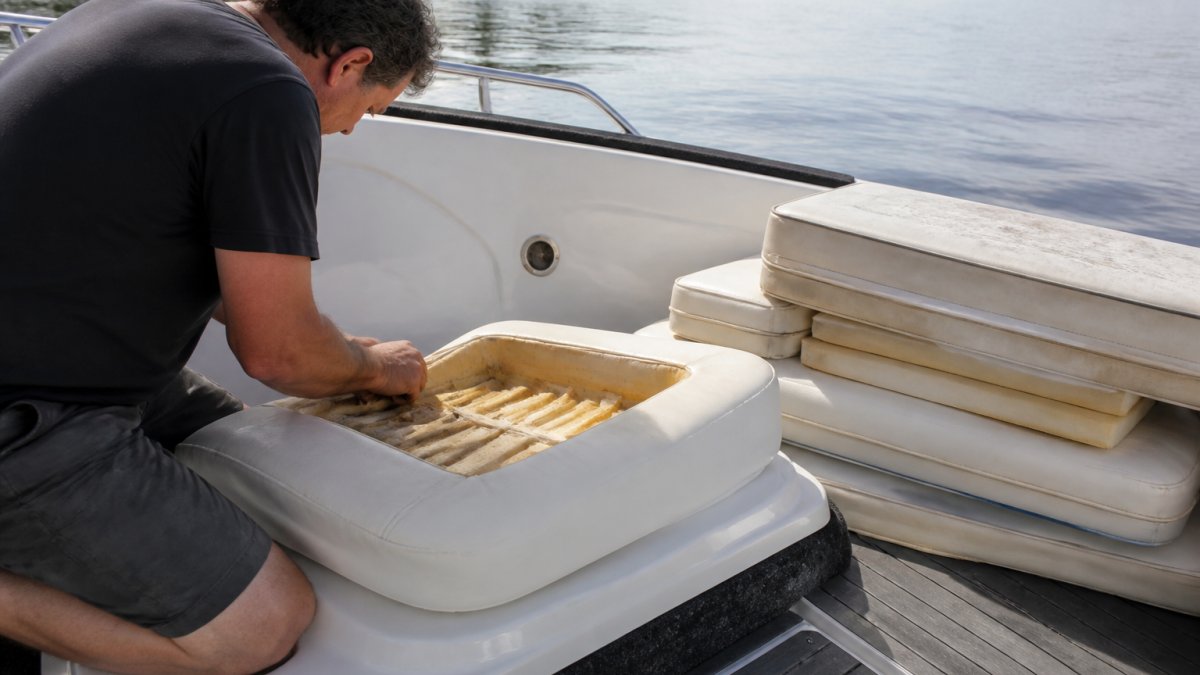
Replacement makes more sense than repair when the foam has lost its structure, not just its cover. Press the center of a seat cushion with your palm. If it stays compressed or feels crunchy, the core is done.
Other signals that point to replacement:
- Vinyl that cracks when you flex it rather than stretching
- Seams that have pulled apart along the stitch line
- Musty odor that returns after cleaning
A cushion with one split seam and firm foam is a repair. A cushion with three of these symptoms is a replacement.
Repairing the Cushion Base and Hardware First
Before you order anything, inspect what the cushion sits on. Marine seating bases are usually plywood, composite board, or molded plastic, and they fail long before the vinyl does. Check for soft spots, delamination, and rusted staples: a base that moves under load will tear a new cover within a season. Replace rotted sections with marine-grade plywood, seal the edges, and re-staple with stainless fasteners.
How to Measure Boat Cushions and Build a Template
Measuring is where most DIY jobs go wrong. A tape measure will not capture a curved bow seat or a cushion that tapers toward the backrest, and length-by-width numbers will not tell a fabricator where the shape changes.
The Templating Workflow We Use
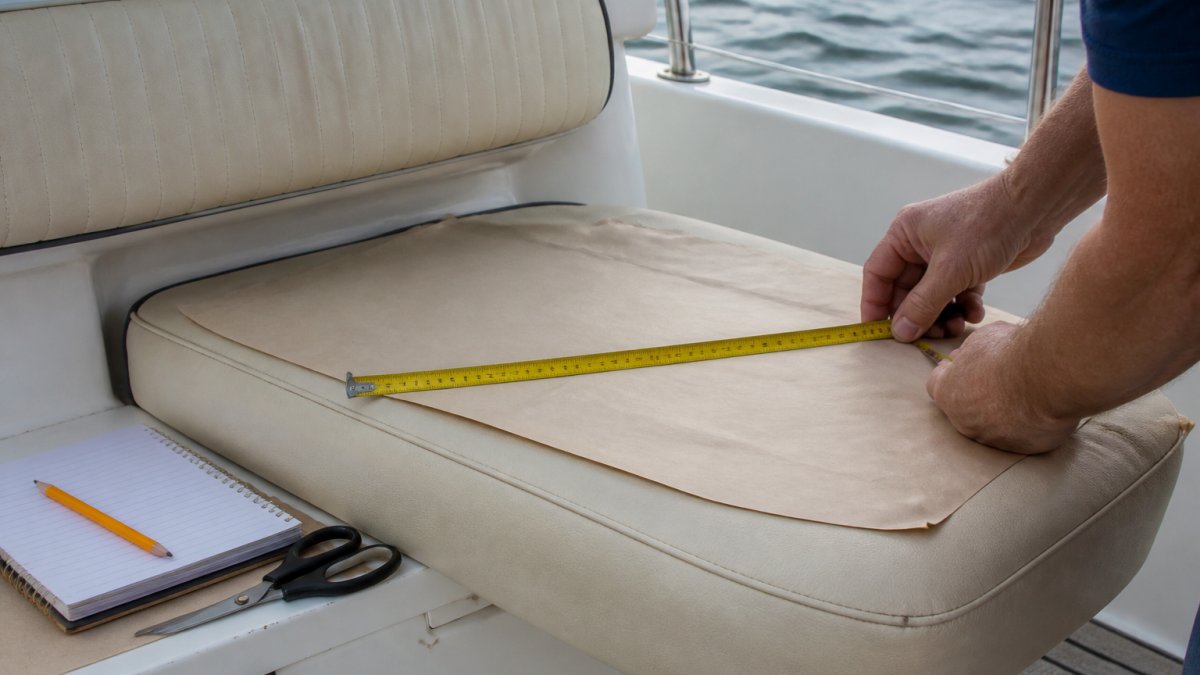
- Remove the old cushion and lay it flat on paper (rosin or heavy craft paper). Tape sheets together on the back side if the cushion is too large for one.
- Trace the outline with a marker, pressing the cushion down. Trace the cover, not the foam, because the cover includes seam allowance and boxing.
- Mark the corners where the cushion meets the gunwale, console, or backrest, using a different symbol for each reference point so the fabricator knows which side faces which structure.
- Note the thickness at the center and each corner, since worn foam sags unevenly. Measure uncompressed; if the foam is crushed, measure the cover depth and note the foam has failed.
- Label each piece with its location (port bow, starboard bench, helm) on the paper before you cut the template.
- Test-fit the paper template on the boat before ordering fabric or foam. A template that fits the workbench but not the boat is the most common ordering error.
Capturing Curves, Angles, and Multi-Piece Layouts
Irregular seating is where templates earn their keep. For a curved bow seat, break the curve into three or four segments, each short enough that a straight edge approximates it.
For V-shaped cushions, measure the included angle at the point of the V and the length of each arm.
For multi-piece layouts, such as a bench with a separate backrest and two corner wedges, create a single layout sheet showing how the pieces relate.
Photographing and Labeling for a Fabricator
Photos are not a substitute for a template, but they resolve ambiguity. Photograph each cushion from directly above with a ruler for scale, plus a side photo showing thickness and profile, and one of the installed position.
Label every photo with the same location names used on the templates (port bow, starboard bow, port bench, starboard bench, helm), and include a simple sketch of the boat layout with each piece numbered.
For a step-by-step walkthrough of measuring curved surfaces, the Canadian Centre for Occupational Health and Safety guidance on safe measuring and tool handling is a useful reference for working safely with cutting tools in tight spaces.
Common Measuring Mistakes That Cause Fit Problems
- Measuring the old foam instead of the old cover. Foam compresses and distorts; the cover holds the true shape.
- Assuming symmetry. Many boats, especially older hulls, are not perfectly symmetrical. Measure both sides separately.
- Forgetting the boxing height. The boxing is the vertical strip between the top and bottom panels; without its height, the new cushion will be the wrong thickness.
Choosing Marine Upholstery Fabric for Sun and Water
Marine upholstery fabric is a solution-dyed vinyl or acrylic textile engineered to resist UV fading, mildew, and water absorption. Standard indoor upholstery will fail on a boat within a single season.
Look for marine-grade vinyl with a mildew-resistant backing and a UV stabilizer built into the vinyl itself, not just a surface coating. For fabric care and cleaning standards, Health Canada's consumer product safety information covers general safety guidance for materials exposed to outdoor conditions.
Weight matters too. Heavier vinyl resists punctures and holds shape better over time, but is stiffer to sew. For bow cushions that see constant foot traffic, go heavier; for backrests, a lighter weight is easier to work with and still durable.
Piping, Seams, and Stitching That Survive the Elements
Piping and seam construction decide how long a cover lasts. A single-stitched seam with no piping will wick water straight into the foam. Use double-stitched seams with UV-resistant polyester thread, piping along every edge that takes abrasion, welt cord sealed at the ends, and seams positioned so water runs off rather than pooling. Standard cotton or nylon thread breaks down under UV within a season, so bonded polyester is the standard for marine work.
Boat Cushion Foam Replacement: Density, Thickness, and Drainage
Boat cushion foam replacement requires closed-cell foam, not the open-cell foam used in household furniture. Open-cell foam acts like a sponge, and once water enters, it stays.
Marine foam is rated by density and firmness. Higher density holds shape longer under repeated compression. Firmness is how much weight it takes to compress the foam a set amount, and it is separate from density: a high-density foam can still be soft.
| Foam Type | Best For | Water Behavior | Notes |
|---|---|---|---|
| Standard open-cell | Indoor furniture only | Absorbs and holds water | Never use on a boat |
| Dry-fast foam | Seat cushions in wet areas | Drains quickly, resists retention | Good balance of comfort and drainage |
| Closed-cell foam | Backrests, long-term exposure | Does not absorb water | Firmer, less plush |
Firmness and Comfort for Back Cushions vs Seat Cushions
Seat cushions and back cushions need different foam, a detail most replacement guides skip. Seat cushions carry body weight and need firmer foam to keep their shape. Back cushions are mostly for support and comfort, so a softer foam feels less rigid against your spine. Using the same foam for both is why so many DIY replacements feel wrong. Thickness follows the same logic: a bow seat cushion typically runs thicker than a backrest, because it must absorb impact and support weight without bottoming out against the base.
Snap-On Boat Cushion Installation and Fastener Options
Snap-on boat cushion installation is the standard for removable seating and the most forgiving system for a first-time replacement. The cushion attaches with snap tabs that press onto a stud mounted on the boat.
Fastener options:
- Snap fasteners: Quick to remove, easy to clean under, best for bow and bench seating
- Hook-and-loop strips: Good for cushions that stay in place but need occasional removal
- Zipper and strap systems: Used where cushions must be fully secured at speed
Snap placement is what matters. Set the studs on the boat first, then mark the matching positions on the finished cushion. Doing it the other way around means your snaps will not line up once the foam is inside.
Cost and Project Time: What to Expect Before You Start
Pricing for a custom boat cushion replacement depends on the number of pieces, foam type, fabric, and how much base repair is needed. There is no single figure for every boat, but you can build a realistic estimate by breaking the project into its parts.
Cost Ranges by Approach
Pricing depends on the number of pieces, foam type, fabric, and how much base repair is needed. Treat these as planning ranges, not quotes.
| Approach | Typical Cost Range (CAD) | What It Includes | Best For |
|---|---|---|---|
| DIY with purchased materials | $300-$900 | Marine vinyl, foam, thread, snaps, tools if you already own a sewing machine | Owners with sewing experience and simple shapes |
| DIY with a fabricator cutting foam and covers | $700-$1,800 | You template and install; a shop cuts foam and sews covers | Owners who want a precise fit without sewing |
| Full upholstery shop (drop off boat or cushions) | $1,200-$3,500 | Measuring, templating, foam, fabric, sewing, and installation | Complex shapes, curved bow seating, or when fit is critical |
| Custom order from a marine cushion specialist | $1,500-$4,000+ | Made-to-order cushions shipped to you; you install | Boats with standard layouts or when local shops are unavailable |
These ranges assume marine-grade vinyl and closed-cell or dry-fast foam. Upgrades that push the total higher include:
- Foam density and thickness. Higher-density foam and thicker cushions cost more per piece; a bow cushion may use two or three times the foam volume of a backrest.
- Fabric selection. A premium solution-dyed vinyl can cost several times more per yard than basic marine vinyl.
- Piping, welting, and double-stitched seams. These add labor and material but extend service life.
Time Estimates
Time depends on whether you do the work yourself or hand it off, and how many pieces are irregular.
- Measuring and templating: 2-4 hours for a simple set; 4-8 hours for curved bow seating or multi-piece layouts.
- Base and hardware repair: 2-6 hours, depending on rot and corrosion.
- Foam cutting: 1-2 hours for flat pieces; 2-4 hours for shaped pieces cut by hand.
A realistic DIY timeline for a three-cushion set with simple shapes is a weekend to a week of evenings; curved bow seating with piping can take two to three weekends. A shop typically turns around a similar set in one to three weeks, depending on backlog and whether you drop off the boat or just the cushions.
Factors That Change the Total
- Number of cushions and whether they are flat or shaped. Shaped pieces take longer to template, cut, and sew.
- Foam type. Closed-cell foam is firmer and more expensive than dry-fast foam; dry-fast foam drains better but may need replacement sooner in constantly wet areas.
- Fabric choice. Solution-dyed vinyls hold color longer but cost more upfront.
For a realistic quote, request pricing based on your specific boat and cushion count rather than a generic online estimate. Ask whether the quote includes templating, foam, fabric, sewing, and installation, and whether base repair is separate. A low quote often excludes base repair or uses lower-grade foam.
Care, Cleaning, and Long-Term Maintenance
Vinyl that is cleaned regularly outlasts vinyl that is cleaned twice a year.
A simple routine:
- Rinse with fresh water after every trip in salt or brackish water
- Clean with mild soap and water, not harsh solvents
- Apply a marine vinyl protectant to slow UV damage
Avoid bleach-based cleaners, which break down the vinyl's protective layer, and never pressure-wash a cushion directly, since it forces water into the seams.
For more on marine material care and safety around cleaning products, Transport Canada's boating safety resources is a useful starting point for owners maintaining their vessels.
Conclusion: Getting the Fit Right the First Time
A custom boat cushion replacement lives or dies on the template. Measure twice, document the shape, and repair the base before you cover it. Most failed DIY jobs trace back to one of those three steps.
If you would rather hand the project to someone who has done it for decades, Creative Custom Upholstery has over 45 years of experience in marine, automotive, and furniture upholstery.
Frequently Asked Questions
How do I measure a boat cushion for a custom replacement?
Measure length, width, and thickness at the widest points, then trace the cushion's footprint onto paper or cardboard to capture curves, notches, and angles. For bow seating or V-shaped cushions, mark the centerline and note where the cushion meets the hull. Record seam locations and snap positions so the new cover lines up. Photograph the cushion from several angles and keep the template with your notes. If you are unsure, a professional upholstery shop can template on site to avoid costly misfits.
What is the best foam for boat seat cushions?
Marine-grade foam with an open-cell or dry-fast structure is the standard choice because it resists mildew and drains water. Density and firmness matter more than brand: seat cushions usually need firmer foam to support weight, while back cushions feel better with softer foam. Thickness affects both comfort and how the cushion sits under a cover. Avoid standard furniture foam, which holds moisture and breaks down quickly in sun and spray. Ask your fabricator which foam suits your seating position and use.
What fabric is best for boat cushions exposed to sun and water?
Marine-grade vinyl remains the most common choice for boat upholstery because it wipes clean, resists UV fading, and handles repeated wetting. Solution-dyed acrylics and other outdoor upholstery fabrics are alternatives when you want a woven look, though they need more care. Look for mildew resistance, UV stabilization, and a backing that will not trap water. Stitching and thread also matter: UV-resistant thread and sealed seams extend the life of any marine upholstery fabric.
Can I replace boat cushion covers without replacing the foam?
Yes, if the foam is still firm, dry, and free of mildew or crumbling. Inspect the foam by pressing it; if it springs back and smells clean, it can be reused. Replace the foam when it is compressed, waterlogged, or stained, because new covers over failing foam will sag quickly. A foam replacement adds cost but restores comfort and support. If you are unsure, a professional can assess the foam during templating and advise whether replacement is worthwhile.
How do I make a snap-on boat cushion?
Start with an accurate template of the seat base and note the existing snap positions. Cut foam to the template, sew the cover with reinforced corners, and install the male snap studs on the boat and female snaps on the cushion. Align snaps before punching holes so the cushion sits flat. Use stainless steel snaps to resist corrosion. Test the fit before final stitching. A snap-on boat cushion should pull taut without wrinkles and release without tearing the fabric.
How long does it take to make custom boat cushions?
Timelines vary with the number of cushions, fabric availability, and how complex the shapes are. Simple rectangular cushions can be completed faster than curved bow seating or V-shaped cushions that need custom templates. Ordering fabric and foam adds lead time. A professional shop will give you a realistic schedule after templating. If you have a deadline, such as a trip or event, share it early so the work can be planned around it.