 how-to
Fixing Stuck Motorized Patio Awnings: 7-Step Guide
Table of Contents
- Before You Start: Safety Checks and What You'll Need
- Common Causes of Stuck Motorized Awnings
- Step-by-Step: Fixing Stuck Motorized Awnings
- Retractable Awning Won't Close: What to Check First
- Motorized Awning Remote Not Working: Remote, Switch, and Battery Checks
- Manual Override for Motorized Awning: How It Works and Its Limits
- Awning Limit Switch Adjustment and Motor Reset
- Repair or Replace? When to Call a Professional
- Frequently Asked Questions
Last Updated: October 21, 2026
Before You Start: Safety Checks and What You'll Need
A motorized patio awning that jams halfway is usually a power, obstruction, or limit-switch problem, not a dead unit. At Creative Custom Upholstery, we've spent more than 45 years building and servicing awnings, and we can tell you the fix is often simpler than homeowners fear. This guide walks through fixing stuck motorized patio awnings step by step, starting with the checks that keep you safe.
Safety comes first, and it is not optional. A retractable awning under tension stores serious energy in its arms and springs. Before you touch anything:
- Cut the power at the breaker, not just the remote. Confirm the motor is dead before you work near it.
- Never stand under a partly open awning. If an arm or bracket looks bent, stay clear.
- Stop work if you see frayed wiring, scorch marks, a burning smell, or a motor that hums but won't move.
- Do not climb on the awning frame or hang from the arms to force movement.
- Call a licensed technician for anything involving the electrical circuit beyond a fuse swap.
What you'll need: a stepladder, work gloves, a screwdriver set, a multimeter, a soft brush, a garden hose, silicone-based lubricant, and your awning's manual. Keep the manual handy for the override and limit-switch steps later.
Common Causes of Stuck Motorized Awnings
Most stuck awnings trace back to a handful of culprits, but the fastest way to find yours is to match the symptom you are seeing to the likely cause.
No response at all (no sound, no movement). This is almost always a power or signal problem. Check the breaker, the fuse, the wall switch, and the remote batteries before suspecting the motor.
Motor hums but nothing moves. A hum with no travel points to a seized or stripped drive system, a jammed arm, or a limit switch that has tripped. Cut power before investigating, because a humming motor under load can overheat quickly.
Moves partway, then stops at the same spot. A consistent stopping point is the signature of a limit-switch setting that is off or a physical obstruction in the track. Clear debris first, then review the limit settings against the manual.
Grinding, clicking, or uneven travel. These sounds suggest worn gears, a dry or rusted joint, or a bent arm dragging on the mechanism. Lubrication may help a dry joint, but grinding usually means a part is worn and needs replacement.
Will not retract fully or sags on one side. A sagging or uneven retract often means a bent arm, a loose bracket, or a spring under unequal tension.
Weather exposure accelerates all of this. Sun, rain, and freeze-thaw cycles wear on seals, wiring, and moving parts, which is why regular awning maintenance matters more than most homeowners realize.
Step-by-Step: Fixing Stuck Motorized Awnings
Work through these steps in order. Each one rules out a cause before you move to the next.
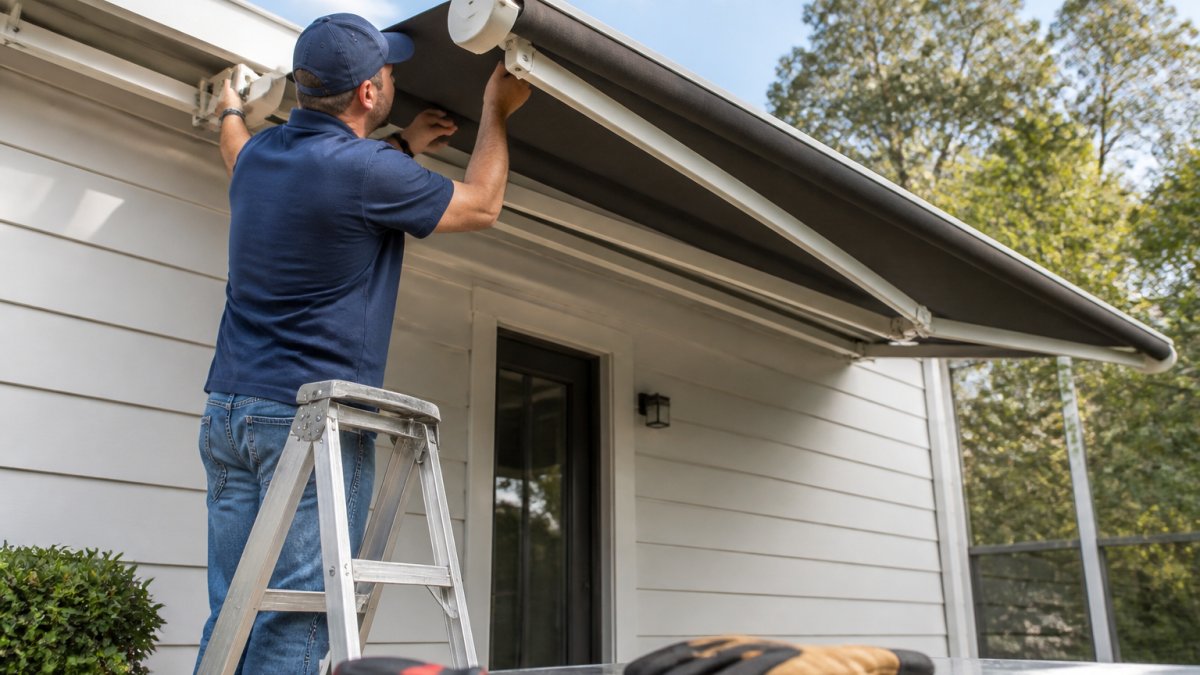
Check the Power Supply, Fuse, and Wiring
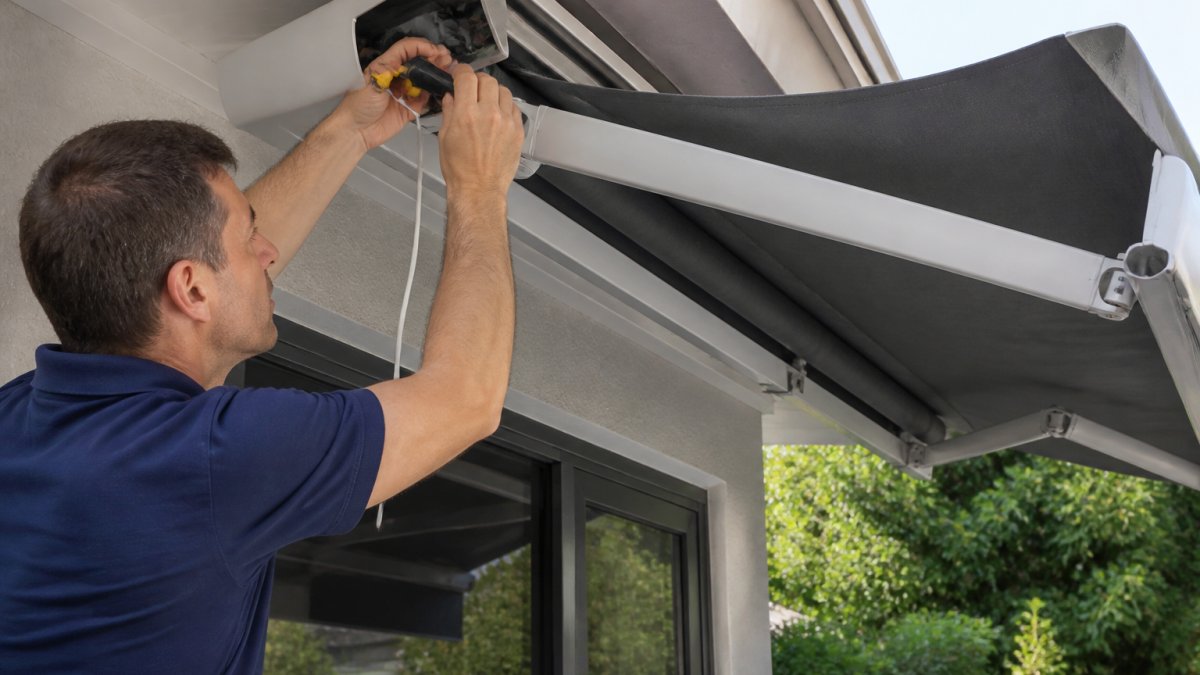
Start at the source. Confirm the breaker is on and the outlet or hardwired connection has power. Test the fuse with a multimeter and replace any blown fuse. Inspect the wiring for loose connections, corrosion, or a short circuit. If the motor gets no power at all, the fault is electrical, not mechanical.
Inspect the Motor and Drive System
A healthy motor makes a steady sound. A grinding, humming, or clicking motor points to motor failure or a jammed drive system. Check that the motor housing is dry and free of rust. Look at the drive shaft and gears for wear. If the motor hums but nothing moves, the drive is likely seized or stripped.
Clear Debris From Tracks, Arms, and Moving Parts
Twigs, leaves, and grit collect in the tracks and around the awning arms. Use a soft brush to clear debris from the tracks, brackets, and joints. A gentle spray from a garden hose can flush out loose dirt. Make sure nothing blocks the arms as they fold.
Lubricate Joints and Inspect Brackets
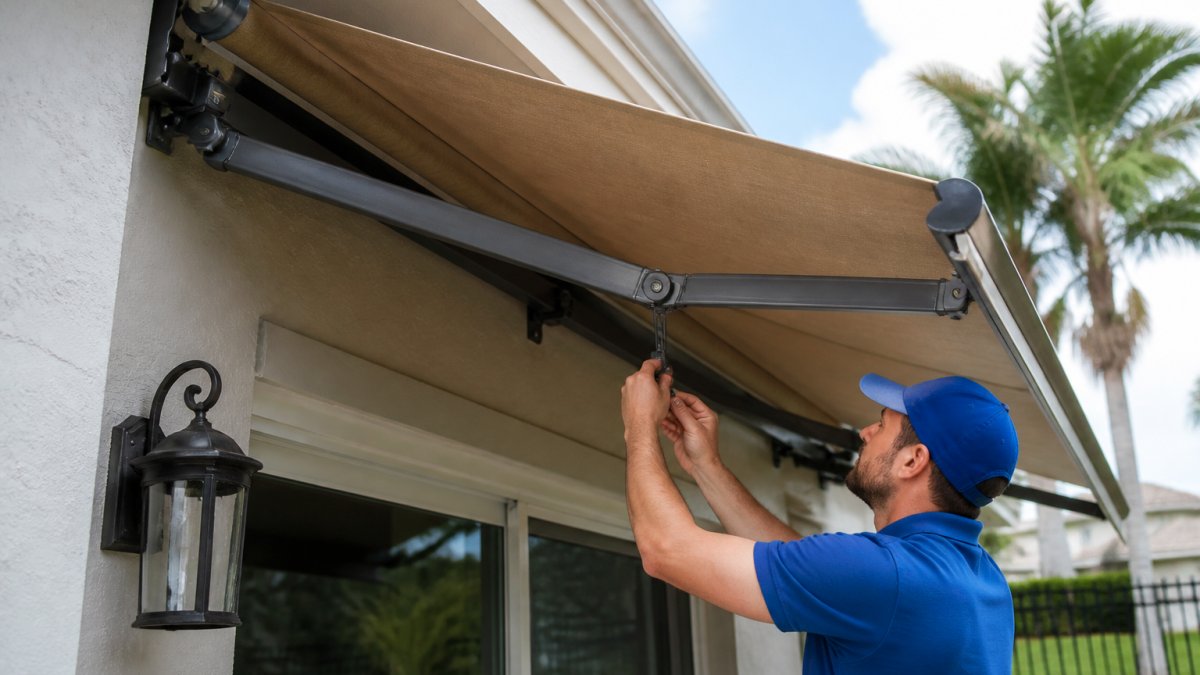
Dry joints are a common cause of a stuck awning. Apply a silicone-based lubricant to the moving parts, joints, and pivot points. Avoid grease that traps grit. While you're there, check the brackets and arms for bends, cracks, or loose bolts. Tighten what's loose and note any part that looks bent.
Retractable Awning Won't Close: What to Check First
When a retractable awning won't close, check the remote battery, the wall switch, and any obstruction in the tracks before assuming the motor is dead. Most "won't close" cases are signal or debris problems, not motor failure.
Run through this quick order:
- Remote battery: swap in fresh batteries and retest.
- Wall switch: try the hardwired switch to bypass the remote.
- Tracks and arms: clear any debris blocking the fold.
- Limit switch: if it stops at the same spot every time, the limit setting is likely off.
If the awning closes partway and stops, that pattern points to a limit switch or a physical obstruction rather than a power fault.
Motorized Awning Remote Not Working: Remote, Switch, and Battery Checks
A motorized awning remote that won't respond is usually a battery or pairing issue, not a broken motor. Test the wall switch first. If the awning moves from the switch but not the remote, the problem is in the remote itself.
Check these in order:
- Batteries: replace them, even if the light still comes on.
- Pairing: re-pair the remote to the motor following the manual.
- Signal: remove obstructions and move closer to the motor.
- Wall switch: a working switch confirms the motor and power are fine.
If neither the remote nor the switch works, go back to the power and fuse checks above.
Manual Override for Motorized Awning: How It Works and Its Limits
Manual override lets you retract a motorized awning by hand when the power is out or the motor has failed. Most units include a manual crank or a release mechanism, but the method varies by model, so check your manual first.
How it typically works:
- Cut power at the breaker.
- Locate the override crank point or release lever, usually at the motor end.
- Engage the override per the manual.
- Crank slowly to retract or extend the awning.
- Disengage and restore power once the awning is safe.
The limits: manual override is for emergencies, not daily use. It won't fix a stripped drive gear, and cranking against a jammed arm can cause damage. Use it to get the awning closed, then book a repair.
Awning Limit Switch Adjustment and Motor Reset
Limit switch adjustment sets how far the awning extends and retracts. If your awning stops short or overruns, the limits need resetting. The exact procedure depends on the model, so follow the manual.
A typical reset flow:
- Cut and restore power to reset the motor's memory.
- Enter adjustment mode per the manual, often by holding a button.
- Run the awning to the desired open and closed points.
- Save the settings and test a full cycle.
A motor reset alone fixes many "stuck halfway" faults. If the awning still stops at the wrong point after a reset, the limit switch itself may need replacing.
Repair or Replace? When to Call a Professional
Some faults are a five-minute fix; others need parts, tools, and know-how most homeowners do not have. The decision comes down to three questions: is the fault electrical beyond a fuse, is a motor or structural part damaged, and are compatible parts still available for your model?
Stop work and call a qualified technician if you see any of the following:
- Frayed, scorched, or exposed wiring, or a burning smell near the motor.
- A motor that hums but will not move, or that trips the breaker repeatedly.
- Bent arms, cracked brackets, or a frame that sags on one side.
- Any fault that requires opening the motor housing or working on the electrical circuit beyond a fuse swap.
- An awning that will not retract and is exposed to wind, since a partly open awning under load is a hazard.
Here is how the common symptoms break down:
| Symptom | Likely Fix | DIY or Pro |
|---|---|---|
| Dead remote or switch | Battery or pairing | DIY |
| Blown fuse | Replace fuse | DIY |
| Debris in tracks | Clear and clean | DIY |
| Dry joints | Lubricate | DIY |
| Motor hums, won't move | Drive or motor repair | Pro |
| Bent arms or brackets | Part replacement | Pro |
| Frayed wiring or short circuit | Electrical repair | Pro |
| Grinding gears | Motor or drive replacement | Pro |
Repair versus replacement comes down to age, part availability, and the condition of the frame and fabric. A motor or arm swap is often the cheaper path when the frame and fabric are sound. Full replacement makes more sense when the frame is rusted through, the fabric is failing, or parts for your model are no longer made. Before you decide, locate the awning model and motor details on the unit or in the manual, then check whether compatible parts and a service manual are still offered. A model-specific manual is the difference between a straightforward part swap and a repair that stalls on a discontinued component.
Cost is the other factor. A simple control or fuse fix is inexpensive, while a motor, wiring, or structural repair carries a higher parts and labor cost. Request itemized quotes so you can compare the repair against the price of a replacement unit on equal terms.
This is where a specialist helps. At Creative Custom Upholstery, our family-owned and operated business handles awning repair and replacement. We quote each job on its own details, so request a quote for current pricing.
Frequently Asked Questions
Why won't my motorized awning roll up?
A motorized awning that won't roll up usually has a power problem, a tripped limit switch, or a remote that has lost its pairing. Check the breaker and fuse first, then test the wall switch. If the motor hums but nothing moves, stop and inspect the arms and fabric for obstruction. If the motor is silent, the fault is likely electrical. Any repair involving the motor or wiring should be handled by a qualified technician.
Can a stuck motorized awning be operated manually?
Many motorized awnings include a manual override, often a crank or a release cord on the motor head. The manual override for a motorized awning is meant for emergencies, not daily use, and it will not work if the arms are bent or the fabric is jammed. Check your owner's manual for the correct override method before forcing anything, since using the wrong procedure can damage the drive system.
How do you reset a motorized awning?
Most motors reset by cutting power at the breaker or isolating switch for about 30 seconds, then restoring it and pressing the remote or wall switch once. If the awning still stops in the wrong position, the limit switch may need adjustment. Limit switch settings vary by model, so follow the manufacturer's instructions. If the awning will not respond after a reset, the motor or control board may need professional diagnosis.
When should I call a professional to repair a motorized awning?
Call a professional when the motor hums but the awning does not move, when you see bent arms, frayed cables, or exposed wiring, or when the awning is stuck fully extended and cannot be retracted safely. Electrical faults, motor replacement, and limit switch adjustment on unfamiliar models are jobs for a technician. A pro can also tell you whether repair or replacement makes more sense for the age and condition of your awning.
A stuck motorized awning is frustrating, but most faults trace back to power, debris, or a limit switch you can check yourself. When the problem runs deeper, don't force it. Creative Custom Upholstery brings over 45 years of experience to awning repair, fabric replacement, and custom cushions, with quality workmanship and a job done right the first time. Get started with Creative Custom Upholstery and request a quote to get your awning moving again.