 how-to
Fix Motorized Awning Retraction Issues Fast
Table of Contents
- Safety First: Before You Troubleshoot a Motorized Awning
- Electric Awning Troubleshooting: Diagnose the Symptom
- Awning Remote Control Not Working? Here's What to Try
- Motor and Drive System: Overheating, Gears, and Cool-Down
- Motorized Awning Limit Switch Adjustment and Fabric Alignment
- How to Manually Retract an Electric Awning in an Emergency
- When to Call a Professional for Awning Retraction Repairs
- Frequently Asked Questions
Last Updated: October 16, 2026
Safety First: Before You Troubleshoot a Motorized Awning
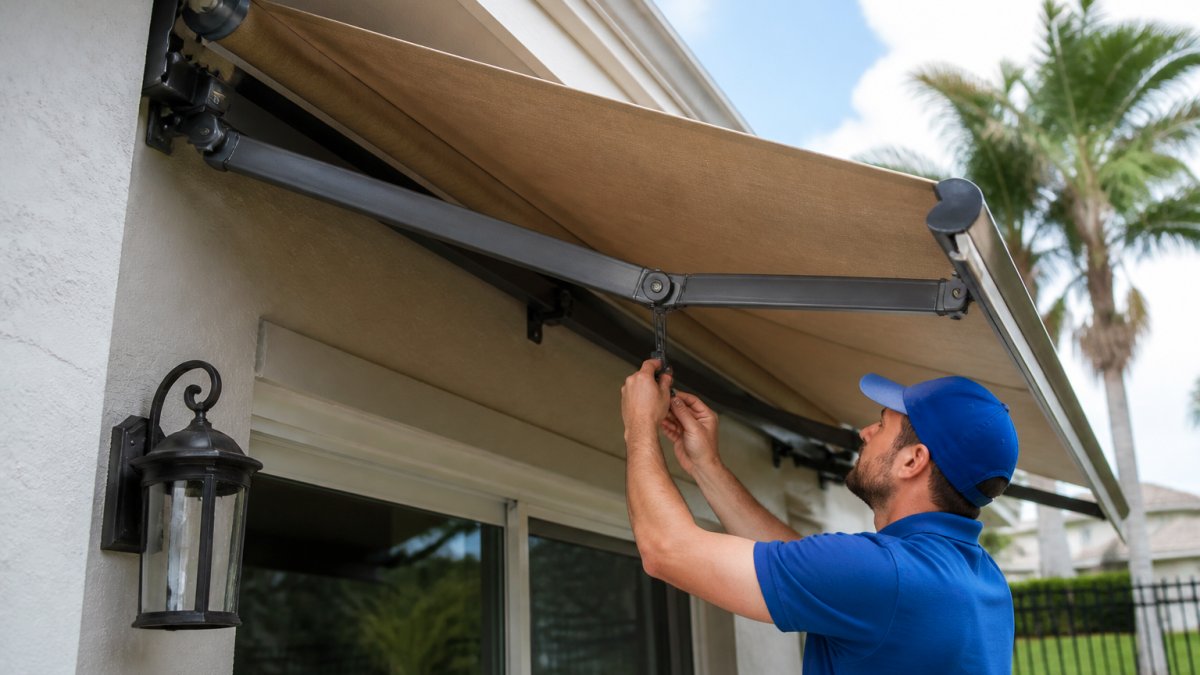
A motorized awning that will not retract is usually an electrical or mechanical fault, not a dead unit. Most issues trace back to a blown 12-volt fuse, a loose wire, a stuck switch, or an overheated motor. This guide from Creative Custom Upholstery walks you through motorized awning retraction step by step.
Before you touch anything, cut the risk. A retractable awning under tension can snap back hard if you release the wrong part.
- Disconnect 12-volt power at the battery or fuse panel
- Never put your hands near the roller tube or arms while power is on
- Keep children and pets clear of the awning footprint
Give yourself 10 to 15 minutes for basic checks. Most retraction faults are simple. A few need a technician.
Electric Awning Troubleshooting: Diagnose the Symptom
Start with the symptom, not the parts. Narrow the fault to one of four systems before removing a screw: power, control, motor, or mechanical.
| Symptom | Likely System | First Check |
|---|---|---|
| Nothing happens at all, no sound | Power | Fuse box, battery voltage, ground |
| Nothing from remote, wall switch works | Control | Remote battery, receiver pairing |
| Nothing from wall switch, remote works | Control | Switch contacts, wiring to motor |
| Single click, then silence | Power or motor | Voltage at motor under load, thermal cutout |
| Motor hums, awning won't move | Mechanical | Jammed gear, binding roller tube, debris |
| Works from wall switch, not remote | Control | Remote battery or pairing |
| Stops halfway, won't finish | Control or mechanical | Limit switch settings, fabric misalignment |
| Moves slow or grinds | Mechanical | Debris in tracks, dry joints, worn gears |
| Retracts partway, then reverses | Control | Limit switch drift, obstruction sensor |
Most failed retractions are electrical or control faults, not dead motors.
The Four-System Decision Path
Work through the systems in this order, eliminating a category before you move on.
- Power. Confirm 12V reaches the awning circuit. If the fuse is blown or voltage is low, stop here. Nothing downstream will work.
- Control. Confirm the switch or remote sends a signal. If the motor clicks or hums when you press the switch, power and control are working and the fault is downstream.
- Motor. Confirm the motor receives voltage and responds. A motor that is silent with confirmed voltage at its terminals is either failed or in thermal shutdown.
- Mechanical. Confirm nothing binds the roller tube, arms, or fabric. A motor that hums but does not move is almost always fighting a mechanical load.
Check 12-Volt Power, Fuses, and Shore Power
The 12-volt supply is the first thing to test. A retractable awning draws real current, so a weak battery or corroded connection stops it cold.
- Find the awning's fuse in the 12V panel and check for a break
- Test battery voltage with a multimeter (12.6V or higher at rest)
- Confirm shore power is connected if the awning runs off the converter
A blown 12V fuse is the most common single cause. Replace it with the same rating. Never upsize the fuse to "make it work", that risks a fire.
Test the Wall Switch and Wiring Connections
If the fuse is good, the wall switch is next. A stuck or failed switch sends no signal to the motor.
- Remove the switch plate and inspect the back
- Test for 12V at the switch with the multimeter
- Press the switch and listen for a click from the motor
If you get power at the switch but nothing at the motor, the fault is in the wiring between them. Trace the run for a pinch or break.
Electrical Testing Beyond the Fuse
A multimeter turns guesswork into diagnosis. Set it to DC volts and work from the source outward.
- At the battery or converter: confirm 12.6V or higher at rest, and no more than a 0.5V drop when the awning is commanded to run.
- At the fuse: confirm voltage on both sides of the fuse with the circuit live. Voltage on one side only means the fuse is open.
- At the switch: confirm 12V on the supply terminal, then confirm 12V on the output terminal when the switch is pressed.
If voltage is confirmed at the motor and it still does nothing, the fault is in the motor or its thermal cutout, not the wiring.
Awning Remote Control Not Working? Here's What to Try
A dead remote is rarely a dead awning. When the remote fails but the wall switch works, the problem is in the remote or receiver, not the motor.
- Swap in a fresh remote battery first
- Re-pair the remote to the receiver per the manufacturer's steps
- Check the receiver's antenna wire for damage
If the wall switch works and the remote doesn't after a new battery and re-pair, the receiver is the likely culprit. That's a replaceable part, not a full awning replacement.
Motor and Drive System: Overheating, Gears, and Cool-Down
Motors overheat and shut down to protect themselves, so the awning won't retract until it cools. Give it 15 to 20 minutes, then try again. If it retracts normally, the motor is working too hard, usually from a binding roller tube, dry gears, or debris in the tracks.
- Listen for grinding, which points to worn gearwheels
- Check the drive system for stripped gears
- Lubricate the joints and moving parts with a dry lubricant
Motorized Awning Limit Switch Adjustment and Fabric Alignment
A limit switch tells the motor when to stop. When it drifts, the awning stops halfway or won't fully retract. Adjust it a quarter turn at a time, testing the retraction after each, until the awning seats fully against the roller tube.
- Inspect the awning arms for bends or twists
- Check the roller tube for a bow
- Confirm the fabric rolls evenly with no wrinkles
A retraction gap at one end usually means a bent arm or a fabric that's off-center. Fix the alignment before you blame the motor.
How to Manually Retract an Electric Awning in an Emergency
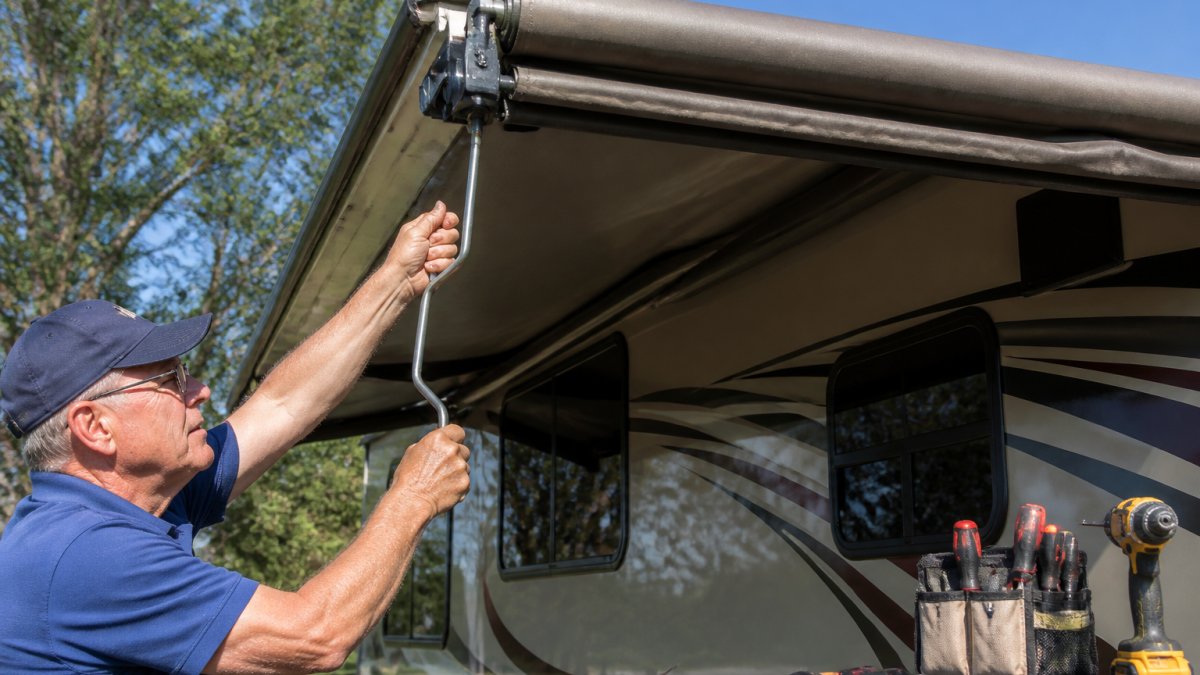
When the motor is dead and you need the awning in now, manual retraction is your backup. Most electric awnings have a manual override: a hand crank, a motor release lever, or a hex-drive port.
Safety Precautions Before You Touch the Awning
A retractable awning stores energy in its springs and gas struts. Releasing the wrong part under load can snap an arm back hard enough to break bones. Take these precautions every time.
- Secure the awning first. If the awning is extended and the wind is up, have a second person hold the lead rail or tie it off before you release anything.
- Disconnect 12-volt power at the battery or fuse panel. Do not rely on the switch being off. Pull the fuse or disconnect the negative terminal.
- Identify pinch points. The arm joints, the roller tube ends, and the fabric fold are all pinch points. Keep fingers clear of these areas.
Identify Your Awning Model and Locate the Override
The override location varies by brand and model. Check the owner's manual first; if you don't have it, look for these patterns.
- Hand-crank port at the motor end. Many awnings have a hex or square drive port on the motor housing or the roller tube end cap. The crank inserts here.
- Motor release lever or pin. Some models have a lever or pull-pin on the motor housing that disengages the gearbox, allowing the roller tube to turn freely.
- Manual override on the control box. A few models place a small crank socket on the control box rather than the motor.
- Emergency retract strap. A small number of awnings include a strap that bypasses the motor entirely.
If you cannot find the override, do not force anything. Call the manufacturer or a technician with your model and serial number, forcing the wrong part can strip the gearbox.
Step-by-Step Manual Retraction
Once you've identified the override and killed the power, follow these steps.
- Cut all 12-volt power to the awning at the battery or fuse panel.
- Have a second person support the lead rail if the awning is extended.
- Locate the manual override using the model-specific guidance above.
- Insert the hand crank or release the motor per the manual.
- Crank slowly and steadily to roll the fabric in. Do not rush.
- Watch the fabric as it rolls. If it bunches or pulls to one side, stop and correct the alignment before continuing.
- Secure the awning once it is fully retracted, using the travel lock or strap.
- Reconnect power only after the awning is secured and you are clear of the mechanism.
If the Awning Will Not Crank
Heavy resistance or a crank that won't turn usually means the motor release isn't fully engaged, the roller tube is bent, or the fabric is jammed in the tracks. Don't force it. Re-check the release mechanism, inspect the roller tube for a bow, and clear debris from the tracks. If it still won't turn, call a technician, forcing it can turn a repair into a full replacement.
When to Call a Professional for Awning Retraction Repairs
Some faults are DIY. Others need a technician with the right tools and parts.
Call a professional when:
- The motor is confirmed dead and needs replacement
- The roller tube or arms are bent or cracked
- The awning fabric is torn or separating from the tube
- Wiring is damaged inside a wall or ceiling
At Creative Custom Upholstery, we've spent over 45 years working with awnings, marine upholstery, and custom cushions. If your awning needs a new motor, realigned fabric, or a full replacement, we can help.
A stuck motorized awning is frustrating, but most retraction faults come down to power, a switch, or a simple mechanical bind. We offer awning repair and replacement, custom outdoor cushions, and marine-grade upholstery, backed by over 45 years of hands-on experience.
Frequently Asked Questions
Why won't my motorized awning retract?
The most common causes are a blown 12V fuse, a faulty wall switch or remote, a motor that has overheated and needs a 10 to 15 minute cool-down, or debris jamming the tracks. Start by checking the fuse box and testing the switch. If those are fine, inspect the awning arms and roller tube for obstructions or misalignment before assuming the motor has failed.
How do I manually retract an electric awning?
Most electric awnings have a manual override, often a hand crank or a hex key socket on the motor head. Locate the override point on your model, attach the crank, and turn it slowly to roll the fabric in. Never force it if you feel heavy resistance. If the awning won't budge, stop and call a professional to avoid damaging the arms or fabric.
Can a stuck motorized awning be reset?
Yes, many motorized awnings have a reset procedure. Disconnect power for 30 seconds, then reconnect and try the switch again. Some models also have a limit switch adjustment that can be reset if the awning stops partway. Check your owner's manual for the specific reset sequence, as it varies by brand and model.
Is it safe to force a motorized awning closed?
No. Forcing the awning can bend the arms, strip the gears, or tear the fabric. If the motor is dead or the awning is jammed, use the manual override instead. If that doesn't work, leave it extended and call a professional. Repairing a forced awning often costs more than the original fix would have.