 how-to
How to Estimate Upholstery Fabric Yardage Accurately
Table of Contents
- Why Accurate Upholstery Fabric Yardage Matters
- How to Measure Furniture for Upholstery Fabric
- Using an Upholstery Fabric Yardage Chart as Your Starting Point
- How to Calculate Fabric for Cushions
- Upholstery Fabric Pattern Repeat Yardage: Matching Patterns and Directional Prints
- A Complete Worked Example: From Measurements to Final Order
- Waste, Safety Allowance, and When to Confirm Your Estimate
- Frequently Asked Questions
Last Updated: October 19, 2026
Why Accurate Upholstery Fabric Yardage Matters
Running short of fabric mid-project is the most expensive mistake in reupholstery. A second cut from a different dye lot rarely matches, so a short order can mean buying the whole job twice. Learning how to estimate upholstery fabric yardage accurately protects your budget and your timeline.
At Creative Custom Upholstery, we bring over 45 years of experience to every project. The method is not complicated, but it is unforgiving. Guess wrong and you pay for it.
Here is the core problem: fabric is sold by the linear yard or linear meter, but furniture is measured in three dimensions. You are converting a flat length of cloth into a set of curved, padded shapes. That conversion needs a system.
Below, we walk through measuring, charting, calculating cushions, matching patterns, and a full worked example. You will also get a measurement worksheet you can print and fill in.
How to Measure Furniture for Upholstery Fabric
Measure each upholstered piece separately and write down every number. Do not round down and do not skip the sides.
You need six measurements per piece:
- Overall width at the widest point, including arms
- Overall depth from front of seat to back of frame
- Overall height from floor to the highest point
- Seat height from floor to top of the seat cushion
- Arm height and arm width on both sides
- Inside seat depth, front edge to where the back cushion sits
Measure twice with a retractable tape and record in centimeters. Metric keeps the math clean when you convert to linear meters later.
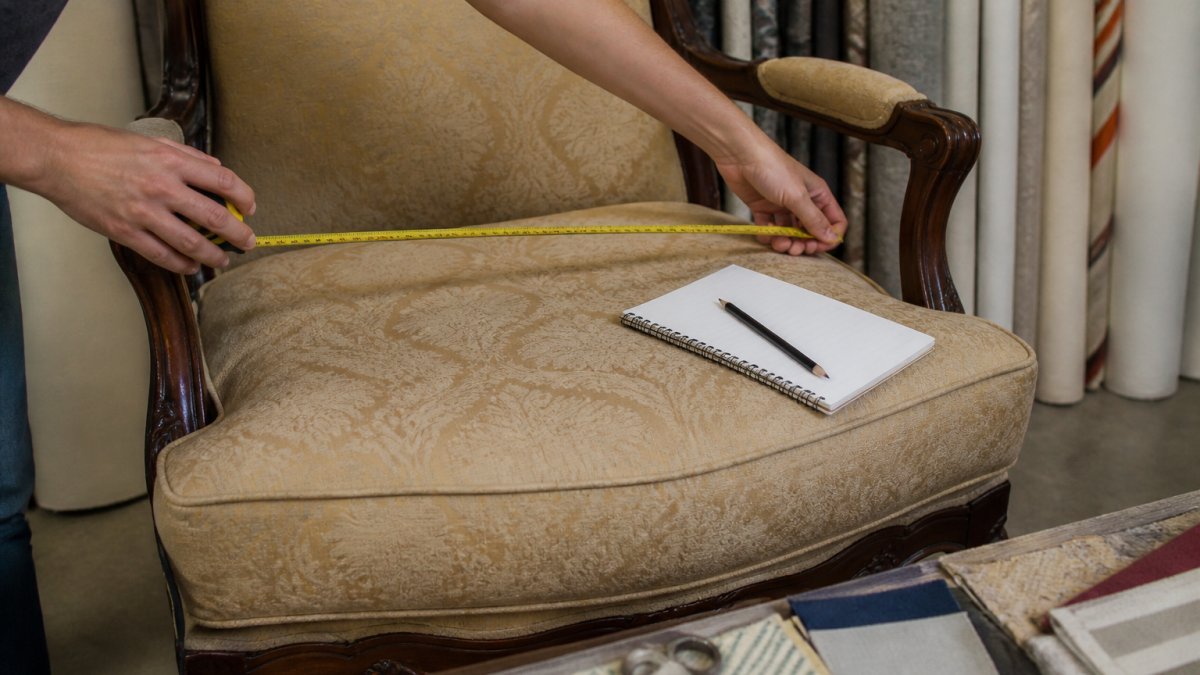
A common mistake is measuring the old fabric after you strip it. Old covers stretch, shrink, and lose shape. Measure the frame and the foam, not the cover.
Using an Upholstery Fabric Yardage Chart as Your Starting Point
An upholstery fabric yardage chart gives you a rough number before you do the real math. Treat it as a sanity check, never as your final order.
A typical chart expresses requirements in linear yards for solid fabric at standard width. Common starting figures look like this:
| Piece | Typical range (linear yards) | Typical range (linear meters) |
|---|---|---|
| Dining chair (seat only) | 1 - 1.5 | 0.9 - 1.4 |
| Armchair or club chair | 5 - 7 | 4.6 - 6.4 |
| Wingback chair | 7 - 9 | 6.4 - 8.2 |
| Loveseat | 10 - 12 | 9.1 - 11 |
| Sofa or couch | 12 - 16 | 11 - 14.6 |
| Sofa with loose back cushions | 16 - 20 | 14.6 - 18.3 |
These ranges assume plain fabric, no pattern matching, and a standard frame. They fall apart the moment you add a large repeat, a small frame, or extra cushions.
The chart's real value is catching errors. If your own calculation lands far outside the range, recheck your measurements before you order.
How to Calculate Fabric for Cushions
Cushions are where estimates quietly fail. A sofa with six loose cushions can need more fabric than the frame itself.
Calculate each cushion as a flattened shape, then add seam allowance:
- Measure cushion length, width, and thickness
- Add the thickness twice to the width (top face plus bottom face plus two sides)
- Add 2 cm seam allowance on every edge
- Multiply length by the adjusted width to get the cut size
- Add 10 percent for compression and alignment
Worked example: a seat cushion 60 cm long, 60 cm wide, and 15 cm thick.
- Adjusted width: 60 + 15 + 15 + 4 cm seam allowance = 94 cm
- Cut size: 60 cm x 94 cm
- With 10 percent allowance: roughly 66 cm x 103 cm
Six cushions at that size, laid out on 140 cm wide fabric, will not all fit side by side. This is why you draw a cut plan before ordering.
Upholstery Fabric Pattern Repeat Yardage: Matching Patterns and Directional Prints
Patterned fabric needs more yardage than solid fabric, and the amount depends on the repeat. Pattern repeat is the distance before a motif repeats, measured vertically and sometimes horizontally. Most charts ignore it entirely, which is why patterned jobs run short.
Start by reading the repeat off the fabric sample or the mill's specification sheet. You will usually see two numbers: a vertical repeat and a horizontal repeat. The vertical repeat drives your cut lengths; the horizontal repeat drives how many pieces fit across the usable width.
Here is how to adjust for common repeat sizes:
- Solid fabric: no adjustment
- Small repeat (under 15 cm): add roughly 10 percent
- Medium repeat (15-30 cm): add roughly 15 to 20 percent
- Large repeat (over 30 cm): add 25 percent or more
- Directional or striped fabric: add extra and plan every piece to run the same way
Those percentages are a starting point. The reliable method is to round each cut length up to the next full repeat, then total the rounded lengths. A 70 cm back panel on a 45 cm repeat becomes 90 cm, because 70 divided by 45 is 1.56, and you round up to two full repeats (2 x 45 = 90 cm).
Horizontal repeat matters just as much when you nest pieces across the width. If a motif repeats every 30 cm across a 140 cm usable width, you can fit four full motifs (120 cm) with 20 cm left over, not four and a half.
Directional prints cannot be rotated to save space. A stripe running up the back must run up the arms too. That constraint costs fabric, and no chart accounts for it.
A large vertical repeat can waste more fabric than the pattern percentage suggests. If your repeat is 60 cm and your longest panel is 65 cm, that panel consumes two repeats (120 cm) instead of one. Always round up per piece, not on the total.
A Complete Worked Example: From Measurements to Final Order
Here is the full method on a three-seat sofa with two loose back cushions, in a medium-repeat patterned fabric. Every number is shown so you can follow the same steps on your own piece.
Step 1: Measure. Overall width 210 cm, depth 90 cm, height 85 cm. Seat height 45 cm, arm height 65 cm, arm width 18 cm, inside seat depth 55 cm.
Step 2: Break into pieces. Two arms (inside and outside faces), one back, one deck, one front rail, two back cushions. Write each piece on its own line.
Step 3: Size each piece with seam allowance. Add 2 cm per edge (4 cm per dimension) for seams and trimming.
| Piece | Finished size (cm) | Cut size with seam allowance (cm) | Quantity |
|---|---|---|---|
| Arm (inside and outside) | 90 x 70 | 94 x 74 | 2 |
| Back panel | 210 x 80 | 214 x 84 | 1 |
| Deck | 210 x 90 | 214 x 94 | 1 |
| Front rail | 210 x 30 | 214 x 34 | 1 |
| Back cushion | 100 x 60 | 104 x 64 | 2 |
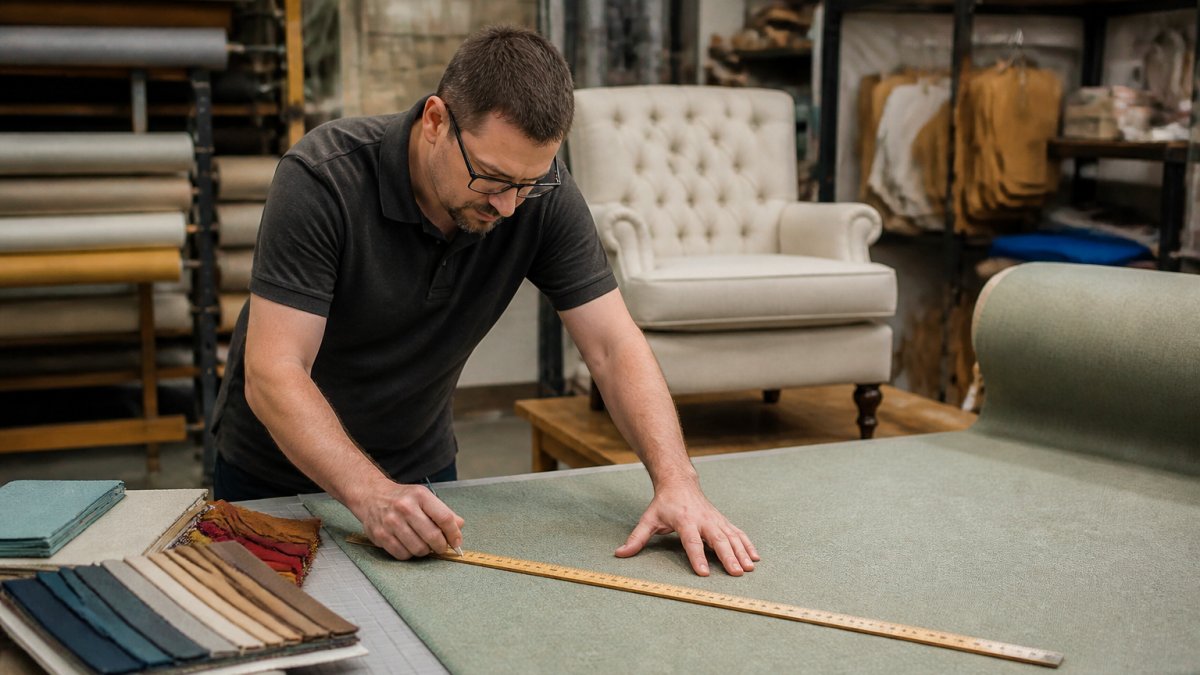
Step 4: Confirm usable width. The roll is 140 cm wide, but selvedges and defects typically remove 2-4 cm per side. Assume 135 cm usable. This single adjustment changes how many pieces fit across the width, so do it before you draw the plan.
Step 6: Apply pattern repeat. With a 45 cm vertical repeat, round each cut length up to the next full repeat:
- 74 cm arm becomes 90 cm (two repeats)
- 84 cm back becomes 90 cm (two repeats)
- 94 cm deck becomes 135 cm (three repeats)
- 34 cm front rail becomes 45 cm (one repeat)
- 64 cm cushion becomes 90 cm (two repeats)
Step 7: Total the planned length. Add the rounded lengths as they sit in your cut plan, not as a simple sum of every piece.
Step 8: Add waste allowance. Add 15 percent for matching, seams, and trimming: 540 x 1.15 = 621 cm.
Step 9: Convert to linear yards. Divide by 91.44 (the number of centimeters in a yard): 621 / 91.44 = 6.79 yards. Round up to the next half yard: order 7 yards.
Always confirm the fabric's usable width before you draw the plan. Selvedge edges and shrinkage can remove several centimeters from each side, and that difference is often the reason a cut plan that looked fine on paper fails at the cutting table.
A worked example is only useful if you can reproduce every line. Measure, size with seam allowance, confirm usable width, draw the plan, round per piece for repeat, total, add waste, then convert. Order once, from one dye lot.
Waste, Safety Allowance, and When to Confirm Your Estimate
Every estimate needs a buffer. Cutting waste, pattern matching, and small errors all consume fabric you planned to keep.
Use these allowances as a rule of thumb:
- Solid fabric, simple frame: 10 percent
- Patterned fabric, small repeat: 15 percent
- Large repeat or directional print: 20 to 25 percent
- First-time project or unusual shape: 25 percent or more
Unusual shapes deserve special care. Curved backs, tufted panels, and rolled arms waste more fabric than flat panels because offcuts cannot be reused. Sketch the shape and mark where the grain must run.
When should you stop estimating and ask a professional? Three cases:
- The piece is antique or has non-standard construction
- The fabric is expensive or has a large repeat
- The job includes piping, tufting, or a skirt
If you would rather not gamble on a family heirloom, have the yardage confirmed before you buy.
Estimating upholstery fabric yardage rewards patience. Measure the frame, chart a starting figure, calculate cushions properly, adjust for pattern repeat, then add a real allowance. Do that and you order once.
If the piece matters to you, let Creative Custom Upholstery handle the measurement and cut plan. Our family-owned shop brings over 45 years of experience to furniture, marine, automotive, and commercial seating, and we get the job done right the first time. Request a quote and we will confirm your yardage before you buy a single meter.
Frequently Asked Questions
How much extra upholstery fabric should I allow for waste and pattern matching?
Add 10 to 15 percent to your base upholstery fabric yardage for cutting waste, seam allowances, and mistakes. If your fabric has a large pattern repeat or a directional print, add 20 to 25 percent instead. For a sofa needing 14 linear meters before adjustments, that means ordering roughly 16 to 17.5 linear meters with a large repeat. Round up to the nearest half meter and confirm with your supplier before ordering, since dye lots can vary between production runs.
How much fabric do I need to reupholster a chair?
A dining chair typically needs 1.5 to 2 linear meters of fabric, while an armchair or club chair needs 6 to 8 linear meters. A wingback chair runs larger, usually 8 to 10 linear meters. These figures assume a solid fabric with no pattern repeat. Add 20 to 25 percent for patterned or striped fabric, and measure the individual upholstery pieces rather than relying on the chart alone. Cushions, skirts, and piping all consume extra yardage.
How does fabric width affect my upholstery fabric yardage estimate?
Standard upholstery fabric comes in rolls about 140 centimeters wide, though some run 115 or 150 centimeters. Usable width is narrower once you subtract selvedge edges, usually 2 to 5 centimeters per side. A wider fabric lets you fit larger upholstery pieces side by side on the cut plan, which can cut total yardage significantly. Always calculate using usable width, not the full roll width, and check the exact figure on the fabric specification before you order.
Can I estimate upholstery fabric yardage from furniture measurements alone?
Yes, for simple pieces. Measure each panel you plan to replace, add seam allowance, then lay the pieces out on graph paper using your fabric's usable width to see how many linear meters you need. Complex shapes, curved arms, tufting, and skirts make this harder, and that is when a professional upholsterer or fabric supplier should confirm your estimate before you commit to an order.