 how-to
How to Calculate Upholstery Fabric Yardage
Last Updated: October 23, 2026
Quick Summary
To calculate upholstery fabric yardage, measure each panel at its widest point, add seam allowance, total the panel areas, then divide by the fabric's usable width rather than the roll width. Add a 10-15 percent waste allowance, plus extra for pattern repeat, cushions, piping and skirts, and round up to the next half metre.
- Measure every panel separately at its widest point and write each number down.
- Divide total fabric area by usable width, not the roll width printed on the label.
- A 140 cm roll with 2.5 cm selvage each side leaves about 135 cm usable width.
- Add one full pattern repeat to each cut length, then round up to the nearest repeat.
- A boxed seat cushion needs roughly 1.1 m² before you add it to the panel total.
Table of Contents
- Step 1: How to Measure Furniture for Upholstery Fabric
- Step 2: Calculating Fabric From Component Dimensions
- Step 3: Fabric Width, Usable Width, and Selvage
- Step 4: Upholstery Fabric Pattern Repeat Yardage
- Step 5: Cushions, Skirts, Piping, and Detail Allowances
- Using an Upholstery Fabric Calculator and Yardage Chart
- Reducing Waste With a Cutting Layout
- Frequently Asked Questions
Step 1: How to Measure Furniture for Upholstery Fabric
Calculating upholstery fabric yardage starts with measuring the piece you plan to recover. At Creative Custom Upholstery, we have helped clients avoid the "ran out halfway through" problem for more than 45 years, and it almost always traces back to sloppy measuring.
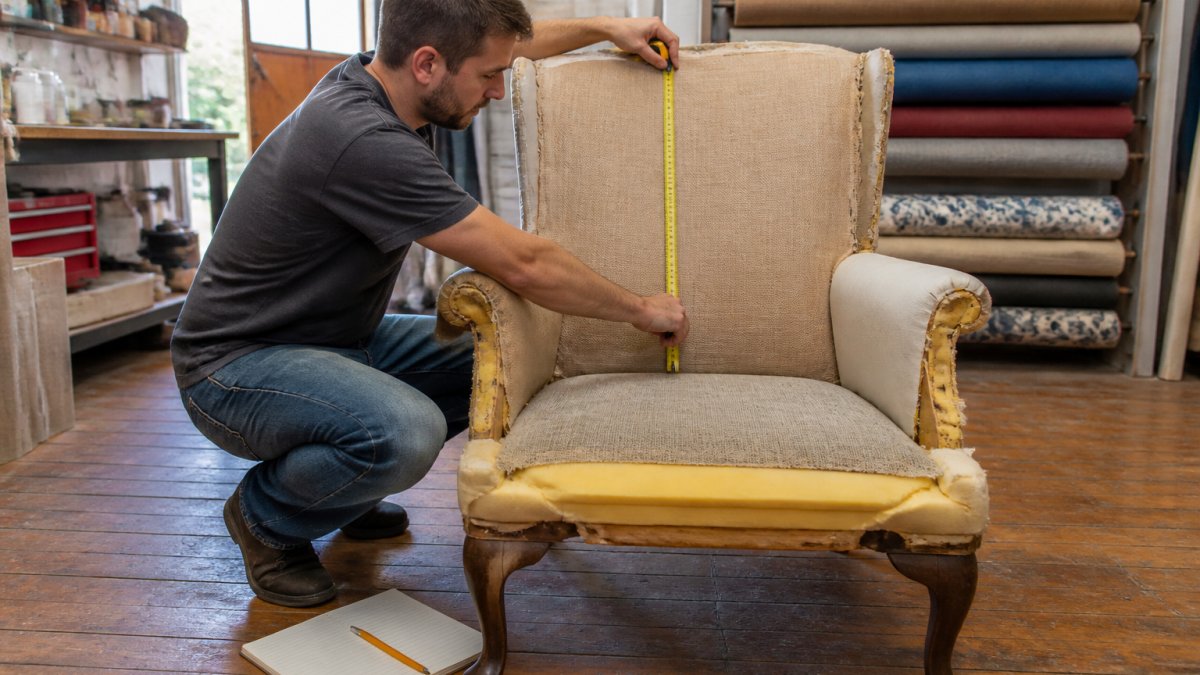
Breaking the Piece Into Components
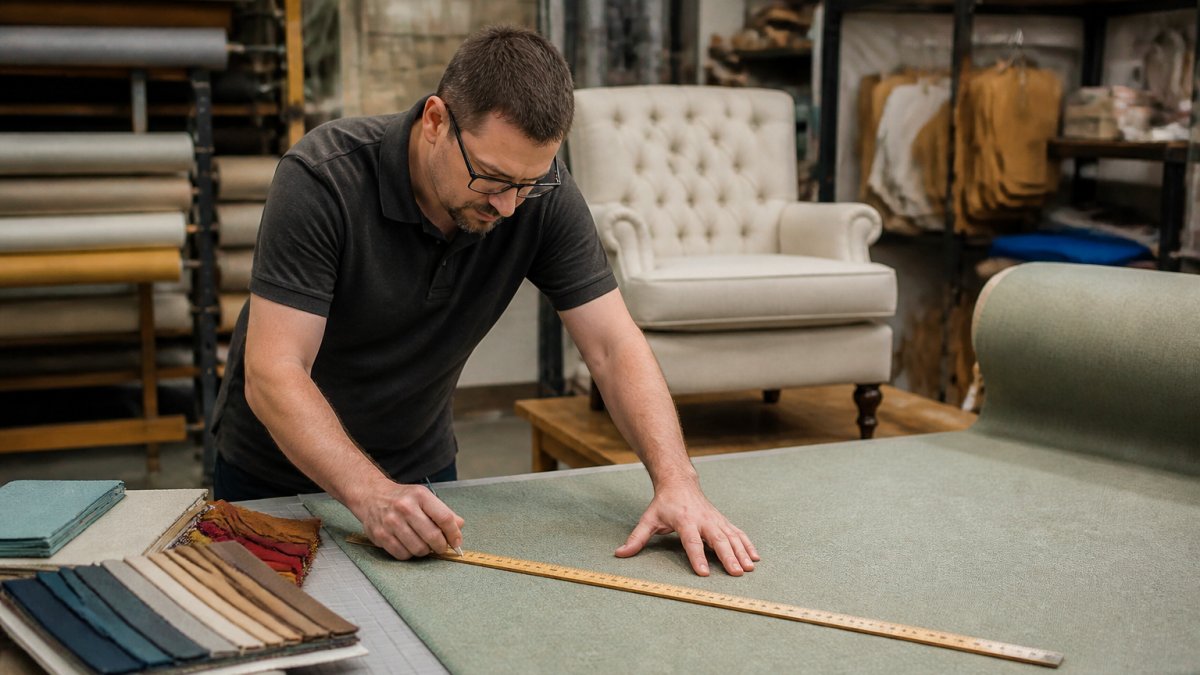
Treat the furniture as a set of flat panels, not one big object. Measure each panel at its widest point, then add a few centimetres on every side for seams and pull. A common mistake is measuring the finished outer edge. If you want a second walkthrough of this step, our guide on how to estimate upholstery fabric yardage accurately breaks the same process down panel by panel.
Step 2: Calculating Fabric From Component Dimensions
Fabric is sold by area on a roll of fixed width, so the job is to turn your panel list into a total area, then back into a linear length you can order. Most charts skip this step and hand you a range. Here is the full calculation, worked end to end.
The Four-Step Formula
- Multiply each panel's length by its width to get its area.
- Add every panel area together for total fabric area.
- Divide the total area by your fabric's usable width to get linear length.
- Add a waste and matching allowance, then round up to the next half metre.
Step 3 is where most home estimates fail: people divide by the roll width printed on the label instead of the usable width after selvage. Step 4 is where they under-order. Both are covered below and in the next section.
Worked Example: An Armchair From Panels to Purchase
Take a simple armchair with these approximate panels, measured at the widest point with a 3 cm seam allowance already added on every side:
| Panel | Length (cm) | Width (cm) | Area (m²) |
|---|---|---|---|
| Inside back | 70 | 60 | 0.42 |
| Outside back | 75 | 62 | 0.47 |
| Seat deck | 60 | 55 | 0.33 |
| Inside arm (x2) | 65 | 30 | 0.39 |
| Outside arm (x2) | 70 | 32 | 0.45 |
| Front rail | 60 | 25 | 0.15 |
| Total | 2.21 m² |
Now divide by usable width. On a 140 cm roll with roughly 5 cm lost to selvage, usable width is about 135 cm, or 1.35 m. So 2.21 ÷ 1.35 = 1.64 linear metres. Add a 15 percent waste allowance: 1.64 × 1.15 = 1.89 m.
That number is deliberately conservative. It assumes no pattern repeat and no separate cushion.
Why You Divide by Usable Width, Not Roll Width
Area divided by width gives length only if the width is the width you can actually cut from. A 140 cm roll with 2.5 cm of selvage on each edge gives 135 cm of usable width. Dividing 2.21 m² by 1.40 m gives 1.58 m; dividing by 1.35 m gives 1.64 m. That 6 cm difference is small on one chair and material on a sofa with eight panels.
Setting Your Contingency
A 10-15 percent waste allowance is a common starting point for plain fabric on a standard frame. Push toward 15-20 percent when any of these apply:
- The fabric has a repeat of 10 cm or more, or is directional (stripes, naps, large florals).
- The piece has tufting, curves, or a skirt.
- The old fabric is being replaced on a frame whose condition you have not inspected.
Round up, never down. A half metre of extra fabric is cheap next to a stalled project waiting on a dye-lot match.
If you would rather not run the numbers yourself, a professional assessment will confirm the figure before you buy; our guide on how to estimate upholstery fabric yardage accurately walks the same panels through a second example.
Step 3: Fabric Width, Usable Width, and Selvage
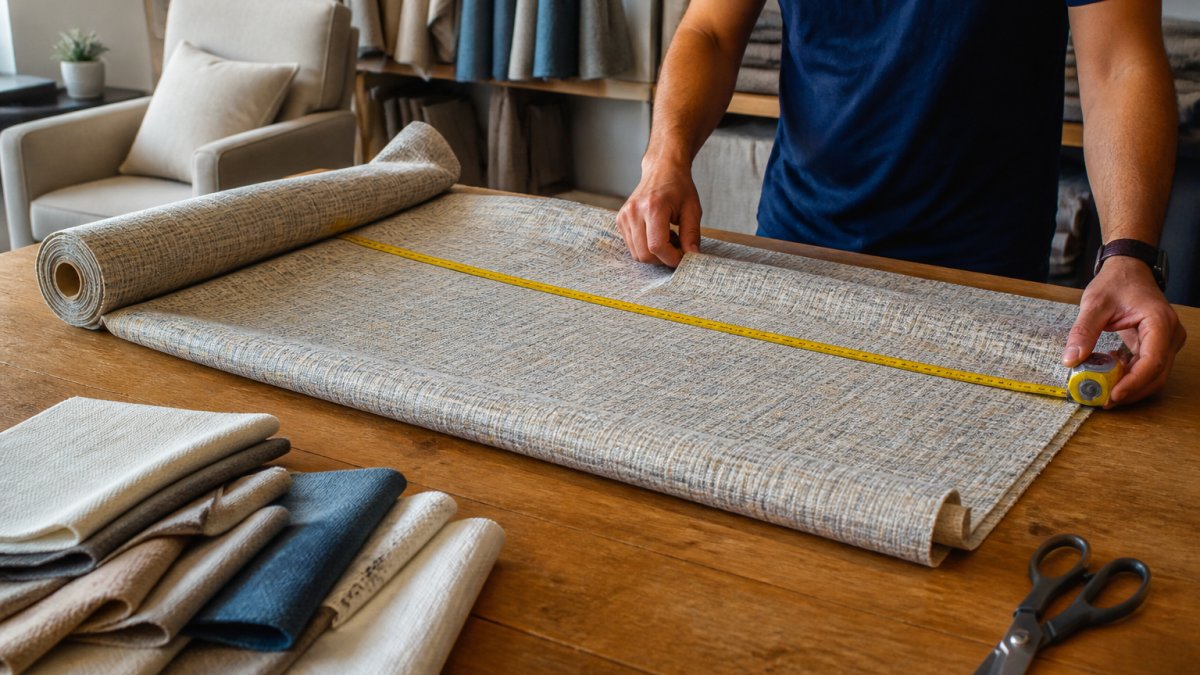
Fabric width is the distance from one edge to the other as it comes off the roll. Usable width is what remains after you trim away the selvage, the tightly woven border on each edge. Selvage cannot be sewn into a seam, so it never counts toward your layout. If a roll is 140 cm wide, plan on a usable width closer to 135 cm.
Step 4: Upholstery Fabric Pattern Repeat Yardage
Pattern repeat is the distance before a motif repeats itself. Directional and large-repeat fabrics need extra length so the pattern lines up across seams. To work out upholstery fabric pattern repeat yardage, add one full repeat to each cut length, then round up to the nearest repeat. Plain fabrics need no allowance. Stripes and large florals can add a surprising amount.
Worked Example: Matching a 14 cm Repeat Across a Sofa
Picture a sofa back panel 180 cm long with a 14 cm repeat. Divide 180 by 14 to get about 12.9 repeats, then round up to 13. That gives 182 cm per panel instead of 180. Do this for every panel that must match, and the extra fabric adds up fast. This is the allowance most home calculators skip.
Step 5: Cushions, Skirts, Piping, and Detail Allowances
Cushions, skirts, and piping each pull extra fabric, and they are the details most likely to push a project over budget after the main panels are cut. The fix is to size each one separately with its own formula, then add the results to your panel total before you apply the waste allowance.
Loose Seat and Back Cushions
A boxed cushion needs fabric for the top, the bottom, and the boxing strip that runs around the edge. The formula is:
- Top and bottom: 2 × (cushion length × cushion width)
- Boxing: cushion perimeter × boxing depth
For a 60 × 60 cm seat cushion with a 12 cm boxing depth: top and bottom are 2 × 0.36 = 0.72 m². Perimeter is 2.40 m, so boxing is 2.40 × 0.12 = 0.29 m².
Back cushions follow the same formula. Knife-edge or pillow-style cushions are cheaper on fabric than boxed cushions because they skip the boxing strip, but they still need top and bottom plus a seam allowance.
Piping and Welting
Piping is cut on the bias, which means the strips run diagonally across the fabric and consume more length than the finished cord suggests. A practical rule is to measure the total length of every seam that will be piped, then multiply by 1.5 to account for bias stretch and joins. A sofa with 8 m of piped seams needs about 12 m of bias strip.
Skirts and Pleats
A skirt needs the drop height plus a hem allowance, multiplied by the distance around the piece, plus pleat or gather allowance. For a sofa with a 3.5 m apron and a 30 cm drop: 3.5 × 0.30 = 1.05 m² for a flat skirt. Add 50 percent for gathers or inverted pleats and you are at about 1.6 m², or roughly 1.2 linear metres.
Putting the Detail Allowances Together
| Detail | Formula | Example Result |
|---|---|---|
| Boxed seat cushion | 2 × (L × W) + perimeter × depth | ~1.1 m² each |
| Knife-edge cushion | 2 × (L × W) + seam allowance | ~0.8 m² each |
| Piping | Seam length × 1.5 × cut width | ~0.5 m² per sofa |
| Flat skirt | Apron length × drop | ~1.05 m² |
| Pleated skirt | Apron length × drop × 1.5-2 | ~1.6-2.1 m² |
Add every detail figure to your main panel total, then apply the 10-15 percent waste allowance from Step 2. On a sofa with two boxed cushions, piping, and a pleated skirt, the details alone can add 3-4 m², which is roughly 2.5-3 linear metres on a 1.35 m usable width. That is the difference between a comfortable order and a second trip to the supplier.
If the piece has tufting, channeling, or a shaped skirt, the detail allowances above are a floor, not a ceiling. A professional assessment will confirm the figure; you can book a custom upholstery service and skip the guesswork.
Using an Upholstery Fabric Calculator and Yardage Chart
An upholstery fabric calculator turns your panel measurements into a purchase figure, but it only works if the inputs are right. Enter usable width, not roll width. Enter pattern repeat, not zero. Feed it every panel and detail. The calculator is a check on your math, not a replacement for measuring.
Reading an Upholstery Yardage Chart
An upholstery yardage chart gives rough fabric requirements by furniture type. Use it as a sanity check, not gospel.
| Furniture Type | Rough Fabric Range | Notes |
|---|---|---|
| Chair | 3-5 metres | Plain fabric, standard frame |
| Bergere or tufted chair | 5-7 metres | Tufting and curves add waste |
| Two-seat sofa | 7-10 metres | Loose cushions add length |
| Three-seat sofa | 10-14 metres | Pattern repeat pushes it higher |
| Loose seat cushion | 1-2 metres each | Depends on cushion depth |
Treat these ranges as a starting point. Fabric width and pattern repeat can move the real figure well outside them.
Reducing Waste With a Cutting Layout
A cutting layout is a plan for how each panel sits on the fabric before you cut. Draw it to scale on paper first. Group long panels along the length, tuck small pieces into gaps, and keep pattern direction consistent. Good layout can save a meaningful slice of fabric on a large project. The goal is to fit every piece with the least leftover, while still respecting the repeat.
Frequently Asked Questions
How much extra fabric should I allow for pattern matching and waste?
The allowance depends on the pattern repeat. For solid fabrics or small repeats under 5 cm, add about 10 percent. For repeats between 5 and 15 cm, add 15 to 20 percent. For large repeats over 15 cm, or for striped and directional fabrics, add 25 percent or more. Always round up to the next half metre or yard rather than down. Running short mid-project means ordering a new bolt, and dye lots can differ, so the extra fabric is cheaper than a mismatched cushion.
How do I calculate fabric yardage for a sofa?
Measure each component separately: back, seat deck, two arms, front rail, and each cushion. Multiply length by width for every piece, then add them together for total fabric area. Divide that total by the usable fabric width to get linear length, then add your pattern repeat and waste allowance. Confirm the final figure with your upholsterer before ordering.
How does fabric width affect the yardage I need?
Fabric width determines how many pieces fit side by side across the roll. Wider fabric means fewer linear metres for the same project. Narrow fabrics under 120 cm may force you to join pieces, which adds seams and extra length. Always calculate using usable width, not the nominal width printed on the bolt label.
How many metres of upholstery fabric do I need for cushions?
A seat cushion needs two fabric pieces per cushion: top and bottom, plus the boxing strip around the edge. For a 60 cm by 60 cm cushion with 15 cm boxing, each cushion uses roughly 1.1 square metres of fabric before waste. Add 20 percent if the fabric has a repeat you must match across the cushion tops. Separate cushion estimates from the frame estimate so you do not double count.
Getting the yardage right is the difference between a smooth reupholstery job and a stalled one. If measuring and cutting feel risky, Creative Custom Upholstery can take it from here. Our family-owned shop brings over 45 years of experience to furniture, cushions, automotive, marine, and awning work, with quality workmanship we stand behind. Request a quote and let us get your project done right the first time.