 comparison
Upholstery Repair vs Furniture Replacement Cost Guide
Table of Contents
- Upholstery Repair vs Furniture Replacement Cost: The Real Comparison
- Furniture Repair Cost: What Drives the Price of a Fix
- Furniture Reupholstery Cost: Fabric, Foam, and Labor Explained
- Reupholster or Replace Sofa: A Like-for-Like Decision Framework
- How Long Does Reupholstery Take, and What Does Downtime Cost You?
- Hidden Conditions, Warranty, and Safety Checks Before You Commit
- Conclusion
- Frequently Asked Questions
Last Updated: October 21, 2026
Upholstery Repair vs Furniture Replacement Cost: The Real Comparison
Upholstery repair is the targeted fixing of a specific problem, such as a torn seam, a sagging cushion, or a broken frame joint, while full reupholstery replaces all fabric and padding on a piece. Furniture replacement means buying new. Comparing upholstery repair vs furniture replacement cost comes down to one number most guides ignore: cost per year of use. At Creative Custom Upholstery, we have watched homeowners compare a repair quote to a showroom price tag and reach the wrong conclusion for 45 years.
Why the Sticker Price Never Tells the Whole Story
A new sofa price and a repair quote are not the same kind of number. One buys you a finished object with a known lifespan. The other buys you additional years on a piece whose frame quality you already know. A cheap replacement sofa might last five years before the frame flexes and the foam flattens. A well-built frame that gets new fabric and foam can run another decade or more. Comparing the two sticker prices alone hides that difference entirely. The honest comparison is total cost divided by years of remaining service.
Furniture Repair Cost: What Drives the Price of a Fix
Furniture repair cost depends on the damage type, not the furniture's retail value. Most guides stop at that sentence. The useful version separates the common repair categories, because a seam fix and a frame rebuild are not remotely the same job. Below is how practitioners typically bracket each type, what drives the number inside that bracket, and how to compare two quotes that were never written on the same scope.
Repair pricing by damage type
Treat these as planning ranges, not quotes. Labor rates, shop overhead, and local market conditions move them, and any shop should confirm after inspection.
| Damage type | What the job involves | Typical planning range (CAD) |
|---|---|---|
| Seam or stitch repair | Re-sewing an open seam, often without removing the cover | $75-$250 |
| Cushion cover replacement | New cover for one or more cushions, foam check included | $150-$600 per cushion |
| Foam or padding replacement | New foam core, wrap, and refit into existing cover | $100-$400 per cushion |
| Spring or webbing repair | Opening the deck, replacing broken springs or webbing, re-closing | $300-$900 |
| Frame joint repair | Clamping, gluing, reinforcing, or splicing a cracked rail | $250-$1,000+ |
| Arm cap or panel replacement | New fabric on a high-wear panel, matched to existing cover | $200-$700 |
| Full reupholstery (for contrast) | Strip, new foam, new fabric, rebuild | See the reupholstery section |
Two patterns matter more than the exact figures. First, anything that requires opening the piece, springs, frame, deep foam, costs disproportionately more than surface work, because labor, not material, dominates. Second, per-cushion pricing scales with cushion count, so a three-cushion sofa repair can approach the cost of a partial reupholstery; at that point, ask whether a partial or full job is the better spend.
What actually moves the number
- Labor hours. Specialized upholstery labor is the largest line item. A frame repair that needs clamping and overnight glue cure takes more shop time than the visible work suggests.
- Access. A dining chair you can carry in is cheaper to service than a sectional that needs pickup, delivery, and storage.
- Matching. Repairing one panel on a faded cover means matching dye lot and pattern alignment, sometimes impossible, which pushes the job toward partial reupholstery.
- Hidden conditions. A quote written before inspection is an estimate. Cracked joints or water damage found once the cover comes off change the scope.
- Warranty and prep. A much lower quote often reflects less prep, cheaper materials, or a shorter workmanship warranty. Ask what is excluded.
How to normalize two quotes
Quotes are only comparable when the scope matches. Before you compare totals, confirm each quote covers the same damage, the same fabric or foam grade, pickup and delivery, and the same warranty length. Ask each shop to itemize labor, materials, and delivery separately. If one quote bundles everything and the other itemizes, ask the bundling shop to break it down. A quote that is 30% lower on a like-for-like scope usually signals a difference in materials or warranty, not a bargain.
Furniture Reupholstery Cost: Fabric, Foam, and Labor Explained
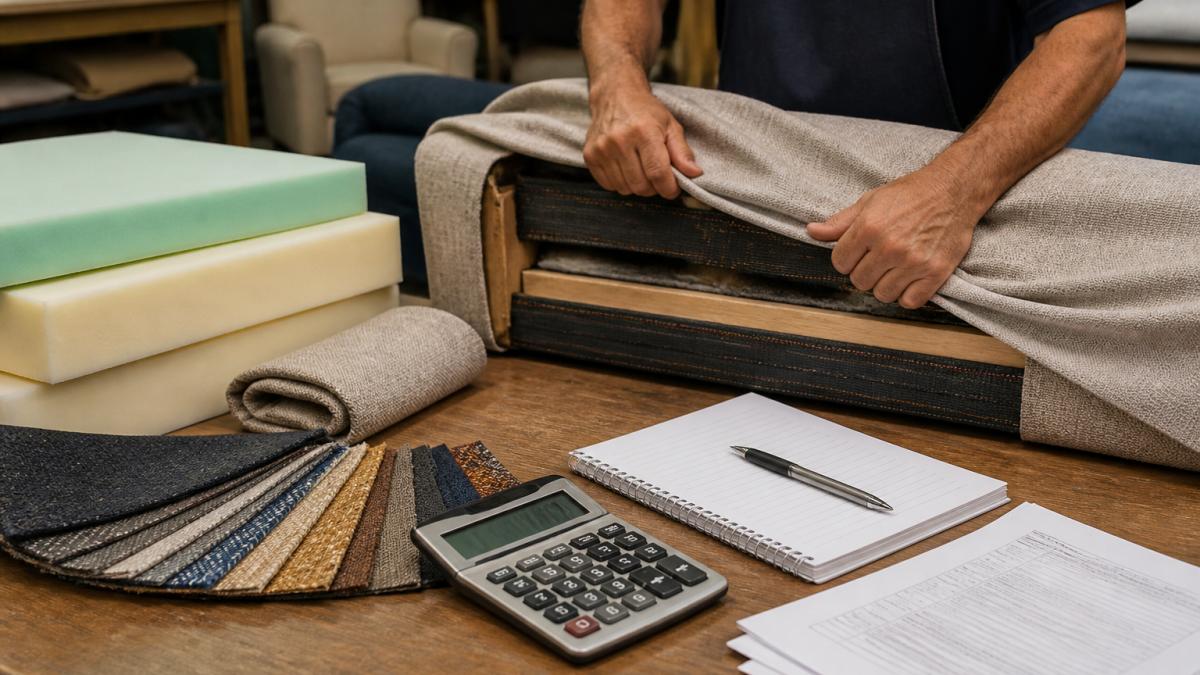
Furniture reupholstery cost is built from three parts: fabric, foam and padding, and labor. Fabric is usually the largest material cost, and it varies enormously by quality, durability, and pattern repeat. Fabric quantity depends on furniture size and project complexity.
Reupholster or Replace Sofa: A Like-for-Like Decision Framework
To decide whether to reupholster or replace a sofa, compare each option on the same terms: total cost, expected lifespan, and quality of the result. The table below is the starting point, but the decision only becomes reliable when you run the numbers behind it.
| Factor | Repair | Full Reupholstery | Replacement |
|---|---|---|---|
| Upfront cost | Lowest | Middle | Highest |
| Expected lifespan added | Months to a few years | Many years | Full new lifespan |
| Keeps original frame quality | Yes | Yes | Unknown |
| Best for | Minor damage | Good frame, worn cover | Failed frame or low-quality piece |
Step 1: Build a like-for-like total for each option
A fair comparison includes every cost the reader will actually pay, not just the headline number.
- Repair total: quoted repair + pickup and delivery (if any) + any matching-fabric surcharge.
- Reupholstery total: labor + fabric yardage × fabric price per yard + foam and padding + pickup and delivery + any frame repair discovered mid-job.
- Replacement total: purchase price + delivery + assembly + removal or disposal of the old piece + any extended warranty.
Most readers forget delivery, disposal, and assembly on the replacement side, which quietly inflates the repair and reupholstery options by comparison. Add them in before you decide.
Step 2: State your lifespan assumptions out loud
The cost-per-year test only works if the years are honest. Use these anchors:
- A cheap replacement sofa is commonly expected to last about five years before the frame flexes and the foam flattens.
- A well-built frame that receives new fabric and foam is commonly expected to run another decade or more.
- A targeted repair buys months to a few years, depending on what else is worn.
If you cannot estimate lifespan, ask the shop doing the work. They see the frame and the foam; you do not.
Step 3: Run the cost-per-year calculation
Divide each option's total cost by the years you expect from it. A worked example makes the mechanic clear:
- Repair at $400 that buys two more years = $200 per year.
- Full reupholstery at $2,000 that adds ten years = $200 per year.
- Replacement at $1,500 that lasts five years = $300 per year.
In that example, repair and reupholstery tie on cost per year, and the tiebreaker becomes quality and sentimental value. Change the assumptions, a longer replacement lifespan, a shorter reupholstery lifespan, and the ranking flips. That is the point: the calculation forces your assumptions into the open where you can challenge them.
Step 4: Apply the quality and condition checks
Cost per year is necessary but not sufficient. Before committing, confirm:
- Frame condition. A sound hardwood frame is the main reason reupholstery wins. A failing frame or particleboard construction makes replacement the honest answer.
- Foam and suspension. If springs and foam are also worn, the reupholstery scope grows and the comparison shifts.
- Replacement availability. If a comparable-quality replacement is hard to find or far more expensive, reupholstery gains ground.
- Sentimental value. A legitimate tiebreaker, but it should not override a structural problem.
Step 5: Decide
If the frame is sound and the piece is well made, reupholstery usually wins on long-term value. If the frame is failing or the piece was disposable to begin with, replacement is the honest answer. If the damage is minor and the rest of the piece is sound, targeted repair is the lowest-cost path. Run the cost-per-year number first, then let the quality checks confirm or overturn it.
How Long Does Reupholstery Take, and What Does Downtime Cost You?
How long reupholstery takes depends on scope and fabric availability. A small repair can be quick, while a full reupholstery of a large sofa takes longer because of stripping, cutting, sewing, and fitting. Fabric that is in stock moves faster than a special order, and complex patterns add time. Downtime is a real cost if the piece is a daily-use sofa or a set of dining chairs needed for a date. Ask for a realistic timeline in writing before you commit, and confirm fabric lead times separately from labor time.
Hidden Conditions, Warranty, and Safety Checks Before You Commit
Hidden conditions surface once the old cover comes off. A frame that looked fine can reveal cracked joints, water damage, or failing springs underneath. Ask the shop how they handle these discoveries: do they stop and quote, or proceed? Get the answer before work starts. Warranty matters too. A written warranty on workmanship and materials tells you how much confidence the shop has in its work. Safety is the third check: worn foam can be a fire concern in older pieces, and failing frames can be unstable.
Conclusion
The real challenge in upholstery repair vs furniture replacement cost is comparing unlike numbers fairly. A repair quote and a new furniture price describe different things, and only cost per year of use puts them on equal footing. If you have a well-built piece with a sound frame, restoring it usually delivers more long-term value than replacing it. Creative Custom Upholstery brings over 45 years of family-owned experience to furniture, marine, automotive, and motorbike upholstery, with quality workmanship aimed at getting the job right the first time.
Frequently Asked Questions
Is it cheaper to reupholster a sofa or buy a new one?
It depends on the sofa's frame and the fabric you choose. A well-built frame with good joints often makes upholstery repair the lower-cost route, especially when you compare cost per year of use rather than the one-time bill. A budget sofa with a particleboard frame usually costs less to replace than to restore. Ask for an itemized quote covering fabric, foam, and labor, then compare it with the replacement price of a sofa of similar quality, not the cheapest one on the showroom floor.
When is it worth repairing furniture instead of replacing it?
Repair makes sense when the frame is solid, the piece fits your space, and the damage is cosmetic or limited to foam and fabric. It also pays off when the furniture has sentimental value or a build quality you cannot buy today at a similar price. If the frame is cracked, joints are loose throughout, or the repair quote approaches the cost of comparable new furniture, replacement is usually the better financial call. Get a professional assessment before deciding.
What affects the cost of reupholstering furniture?
Fabric quality and quantity top the list, followed by labor hours, furniture size, and project complexity. A full reupholstery with pattern matching, piping, and new foam costs more than a partial repair. Frame condition matters too: structural fixes add labor before any fabric goes on. Upholstery fabric is priced per metre, so larger sofas and sectionals use more material. Always ask for a written estimate that separates material cost from labor cost so you can see where the money goes.
What should I ask an upholsterer before getting a quote?
Ask how they measure fabric quantity, whether foam and padding replacement is included, and what the timeline looks like from drop-off to pickup. Confirm how they handle frame repairs and hidden damage found after stripping the piece. Request photos of recent work and ask about warranty terms on stitching and materials. A clear quote should list fabric, foam, labor, and any structural work separately, so you can compare it fairly with the price of new furniture.