 how-to
What It Costs to Reupholster Vintage Dining Chairs
Last Updated: October 26, 2026
Quick Summary
The cost of reupholstering vintage dining chairs depends on labor, materials, and the chair's style and condition. Ask each upholsterer to itemize labor and materials separately and compare line by line. Fabric needs range from about 1 metre for a seat only to 2 to 2.5 metres for a high-back chair.
- Ask for a lump-sum quote to be split into labor and materials so you can compare line by line.
- Seat and back recoveries typically need 1.5 to 2 metres, plus extra for large patterns.
- Victorian and Edwardian chairs carry higher labor because of carving, buttoning, and hand-stitching.
- Two or more loose joints usually mean a full frame tighten, adding hours to the job.
- For residential dining chairs, at least 15,000 double rubs is advisable; heavy use calls for 20,000 or higher.
Table of Contents
- Why Vintage Dining Chairs Cost More Than You Expect
- Dining Chair Reupholstery Cost: What Drives the Price
- How Much Fabric to Reupholster a Dining Chair
- Vintage-Specific Cost Factors: Style, Frame, and Condition
- Reupholster or Replace Dining Chairs: A Decision Framework
- Fabric Selection for Vintage Dining Chairs
- Building a Quote Checklist for Your Vintage Chair Project
- Request a Quote for Your Vintage Dining Chair Restoration
- Frequently Asked Questions
Why Vintage Dining Chairs Cost More Than You Expect
The cost of reupholstering vintage dining chairs rarely matches a quick online search. The chair looks simple, but the work behind it is not.
Below: what drives the price, how to estimate fabric needs, how to judge whether your chair is worth the investment, and a quote checklist for any upholsterer.
Dining Chair Reupholstery Cost: What Drives the Price
Ask each upholsterer to itemize. Then compare line by line, not totals.
Labor and Materials as Separate Line Items
A lump-sum quote hides where the money goes. Ask for the split; if you supply your own fabric, the labor line should drop.
Base-Only Versus Seat-and-Back Recover
For a deeper, chair-specific cost breakdown to compare against these figures, see our guide to antique chair upholstery cost.
How Much Fabric to Reupholster a Dining Chair
Here is a simple planning table: How to Calculate Upholstery Fabric Yardage
| Chair Type | Approximate Fabric | Notes |
|---|---|---|
| Standard seat only | 1 metre | Plain fabric, no pattern matching |
| Seat and back | 1.5 to 2 metres | Add for large patterns |
| High-back chair | 2 to 2.5 metres | More surface area to cover |
| Wingback or armchair | 3 to 4 metres | Not a dining chair, but common in sets |
Vintage-Specific Cost Factors: Style, Frame, and Condition
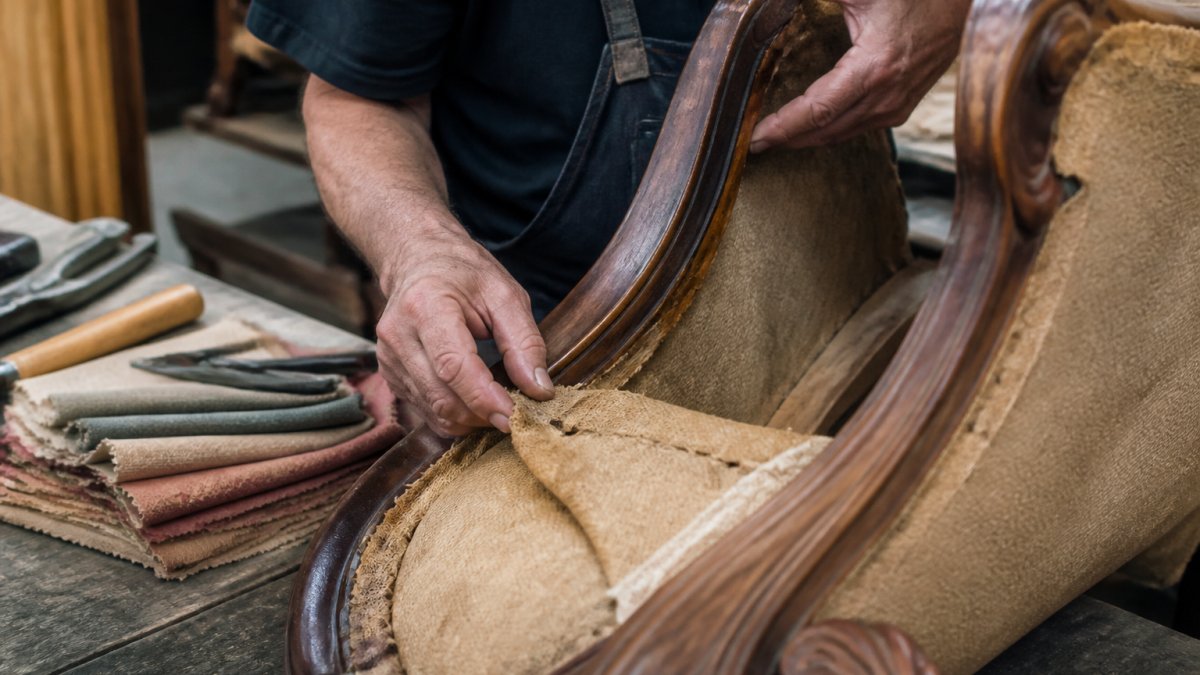
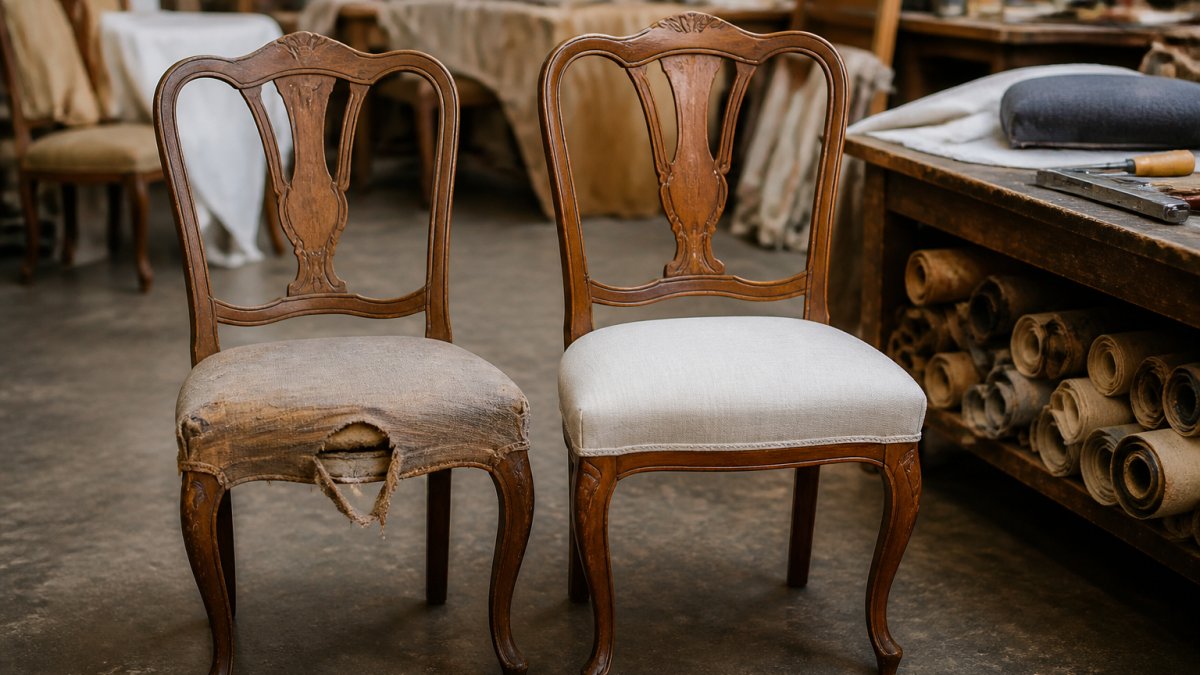
Fillings matter too. Original horsehair can often be reused; crumbling foam cannot. Springs, webbing, and burlap usually need replacing on any chair unused for years.
How Chair Style Changes the Estimate
- Mid-century modern (1950s-1970s): Clean lines, exposed wood frames, foam cushions. Simple geometry means less pattern matching and faster fitting, but foam is usually degraded and must be replaced. Moderate labor.
- Victorian and Edwardian (1830s-1910s): Carved details, curved backs, deep-buttoned upholstery. Horsehair or cotton wadding may be reusable, but complex shapes need more cutting, fitting, and hand-stitching; buttoning alone can add hours. Higher labor.
- Art Deco (1920s-1930s): Geometric shapes and bold patterns demand precise pattern matching. Frames are often hardwood but may have veneer needing careful handling, and sprung seats may need rebuilding. Moderate to high labor.
- Farmhouse and primitive (1800s-early 1900s): Simple wooden seats with woven rush or splint are common. Woven seats need re-weaving, a separate craft; if upholstered, simple shapes keep labor lower.
Frame and Construction Details That Add Cost
- Loose joints and wobbly frames: Repair requires disassembly, cleaning old glue, re-gluing with clamps, and sometimes replacement dowels. Two or more loose joints usually mean a full frame tighten, adding hours.
- Cracked or broken rails: A cracked rail may need splining or replacement. Matching wood species and finish on antiques is difficult, so this skilled work is priced accordingly.
- Carved or turned details: Upholstery must be fitted around carvings without hiding them, often requiring hand-stitching and careful trimming that slows work.
- Spring systems: Vintage chairs may have coil springs tied to webbing or sinuous springs. Rebuilding a spring deck is labor-intensive, so broken or sagging springs usually mean a separate line item.
- Horsehair and natural fillings: These can sometimes be reused after cleaning but often need supplementing with new batting. Brittle or contaminated horsehair must be replaced with modern foam or a natural alternative, adding material cost.
- Unusual fasteners or trim: Decorative nails, gimp braid, or welting must be matched or replaced; sourcing period-appropriate trim adds time and cost.
Condition Assessment: What to Look For
- Frame soundness: Pick the chair up and set it down. Listen for creaks. Try to rack it gently (twist opposite corners). Movement indicates loose joints.
- Seat support: Press down on the seat. Feeling the frame through the cushion means the webbing or springs are likely failing.
- Fabric and filling: Look under the dust cover. Crumbling foam or powdery residue means replacement; dry, brittle horsehair may still be reusable if cleaned.
- Wood finish: Check for water stains, cracks, or missing veneer. Refinishing is a separate cost from upholstery.
Assessing Whether a Vintage Chair Is Worth Reupholstering
Ask yourself three questions:
- Is the frame solid and repairable?
- Does the chair fit your space and style?
- Would you keep it for another decade?
Two yes answers out of three usually justify the work.
Reupholster or Replace Dining Chairs: A Decision Framework
| Situation | Recommendation | Why |
|---|---|---|
| Solid hardwood frame, good design | Reupholster | Preserves quality and value |
| Loose joints, minor cracks | Repair, then reupholster | Frame repair is usually affordable |
| Cracked or warped frame | Replace | Repair cost outweighs value |
| Sentimental or family piece | Reupholster | Replacement cannot match the history |
| Mass-produced, no structural merit | Replace | Little value to preserve |
For a full cost comparison framework to decide whether repairing or replacing is the better financial choice, see our guide on upholstery repair versus furniture replacement.
Fabric Selection for Vintage Dining Chairs
Pattern matching adds cost: large repeats waste more fabric and take more time to line up. If you love a bold pattern, budget for extra yardage.
Durability and Cleanability for Daily Dining
How common upholstery fabrics perform in a dining setting:
- Performance fabrics (e.g., solution-dyed acrylics, treated polyesters): Engineered for stain resistance and colorfastness, often rated 15,000 to 30,000 double rubs (Wyzenbeek), and easy to clean with mild soap and water. Trade-off: some have a synthetic hand and may not suit period authenticity.
- Cotton and linen blends: Natural look and breathability, but not inherently stain-resistant and may absorb spills. Prefer a tight weave of at least 12 ounces per square yard; a stain protector adds cost. Best for formal dining rooms with careful use.
- Leather and vinyl: Easy to clean and very durable. Leather develops a patina and can last decades; vinyl is budget-friendly and wipes clean. Trade-off: leather can be slippery and may not suit all vintage styles, and vinyl may look less authentic. Both suit high-traffic family dining.
- Wool and tweed: Naturally stain-resistant due to lanolin and very durable, wearing well and resisting pilling. Good for mid-century and traditional chairs. Trade-off: wool can be warm, may felt if cleaned improperly, and costs more upfront.
Pattern Matching and Repeat Size
- Small repeats (under 5 cm): Minimal waste, easier matching. Good for small-scale prints.
- Medium repeats (5-15 cm): Moderate waste. Requires careful layout.
- Large repeats (over 15 cm): Significant waste, possibly 20-30% more fabric than a plain fabric, plus added fitting time.
Fabric Weight and Abrasion Ratings
Abrasion ratings (double rubs) indicate wear resistance. For residential dining chairs, at least 15,000 double rubs is advisable; for heavy daily use, aim for 20,000 or higher. Ratings are typically available from the fabric supplier.
Cost Implications of Fabric Choice
When budgeting, ask your upholsterer for a fabric allowance estimate based on your chosen pattern. They can tell you how many metres to order and whether pattern matching will add labor.
Sourcing Fabrics for Vintage Chairs
For vintage authenticity, look for fabrics that mimic period materials: wool damask, cotton velvet, or linen union, often available from specialty suppliers. Modern performance fabrics can replicate the look while offering better durability.
Building a Quote Checklist for Your Vintage Chair Project
- Is the quote itemized into labor and materials?
- Does it include stripping the old cover and fillings?
- Is frame inspection and repair included, or extra?
- Are new foam, batting, webbing, and springs included?
- How much fabric is quoted, and who supplies it?
- Is pattern matching included in the price?
- What is the turnaround time, in writing?
- Can I see photos or references from recent jobs? How to Identify Quality Upholstery Craftsmanship
- What happens if the frame needs unexpected repair?
- Is there a written guarantee on the workmanship?
Request a Quote for Your Vintage Dining Chair Restoration
At Creative Custom Upholstery, we bring over 45 years of experience to every project. We are family-owned and operated. We handle furniture, indoor and outdoor cushions, automotive and marine seating, motorbike seats, and awnings.
Get started with Creative Custom Upholstery.
Frequently Asked Questions
How much does it cost to reupholster vintage dining chairs in Canada?
There is no single rate because vintage dining chair reupholstery cost depends on frame condition, chair style, fabric grade, and whether you recover just the seat or the seat and back. A simple seat recover costs less than a full restoration with frame repair and new foam. Request itemized quotes from at least two upholsterers so you can compare labor, materials, and fabric separately rather than judging a single total.
How much fabric do I need to reupholster a dining chair?
Most dining chairs need about 1 to 1.5 metres of fabric for a seat-only recover, and 2 to 3 metres for a seat-and-back recover. High-back or wingback vintage chairs can require 3.5 metres or more, especially if the fabric has a large pattern repeat. Always confirm yardage with your upholsterer before ordering, and add 10 to 15 percent extra to cover pattern matching and cutting errors.
Is it cheaper to reupholster or replace dining chairs?
Reupholstering is usually cheaper than replacing solid wood vintage chairs with comparable quality new ones, but it can cost more than buying low-priced imports. The decision hinges on frame quality: if the wood is solid and the joints are tight, reupholstering preserves a better-built chair. If the frame is cracked, wobbly, or made of particle board, replacement often makes more financial sense.
Is it worth reupholstering antique or vintage dining chairs?
It is worth it when the chair has a sound hardwood frame, original details you want to keep, or sentimental value. Reupholstering also lets you choose durable modern fabrics and fresh foam that improve comfort and extend the chair's life by decades. It is rarely worth it when the frame needs major structural repair or the chair is a mass-produced piece with little original character.